Lawrence SilverbergWelcome to CITYFOOTCARE.COM,

the Internet home of Dr. Lawrence Silverberg, one the most compassionate and skilled foot doctors in the New York City Metro area and the country.

Dr. Silverberg is Board Certified by the American Board of Podiatric Surgery. Dr. Silverberg’s office is conveniently located in Midtown Manhattan near Grand Central Station.

Dr. Silverberg takes great pride in providing excellent medical care along with great bedside manner and takes the extra time to explain your problems and the treatment options in detail.

At City Footcare we treat all problems related to the foot and ankle. We use state of the art diagnostic and therapeutic equipment.

Dr. Silverberg believes in patient education, and patient participation in their care. He takes pride in spending time with his patients and listening to them. His patients never feel rushed. He also takes histime to explain patients problems in detail and spells out explicit treatment plans.

When your problem requires surgery, you can rest assured that you are in the hands of a competent and highly trained surgeon. Dr. Silverberg has been called the best foot surgeon in NYC and the best bunion surgeon in NYC. The doctor performs all foot and ankle surgery including traditional open surgery, minimally invasive surgery, laser surgery, radio frequency surgery and extra-corporeal shock wave therapy. Dr. Silverberg is an expert in all aspects of foot surgery. He is very detail oriented from start to finish. A good surgical outcome starts prior to entering the operating room. After expertly diagnosing patients’ conditions, he plans out his procedures with great skill. In the operating room he is skillful and precise. He also takes into consideration aesthetics with his incision planning and plastic surgery type suturing techniques.

He is hospital and surgery center affiliated.

To resolve all of your foot and ankle problems, simply look around this site and make an appointment with Dr. Silverberg today. Your feet will be glad you did!
Subscribe:

Lawrence Silverberg, DPM
City Footcare, PC
20 E. 46th Street
(Between Madison and Fifth)
New York, NY 10017
(212) 871-0800
www.cityfootcare.com
CityFootcare@gmail.com
DSCN2347 medium  (1)

See our main site: www.cityfootcare.com

Blog Posts are Below:

Dr. Silverberg quoted for NBC’s Today Show on: Pregnancy Foot Problems.

I’m pleased to announce I was asked to contribute to a story on NBC’s Today Show (Moms Section image) on High Heels and Pregnancy.

I was asked about foot problems women face during pregnancy and my opinion on wearing high heels during pregnancy.

Click the below picture to go to the article.

image

Bunion Surgery Including before and after pictures of bunion surgery.

Updated 2013 03-03
Originally posted 2010 11-18
Bunion surgery is the most common foot surgery I do. Before I tell you about the actual surgery, I will describe what a bunion is and how a patient gets one. Below is a picture of a severe bunion deformity and a moderate to minor bunion.  See further below for before and after bunion surgery pictures. (Click any picture to enlarge)

image image

Bunions are also called “hallux abducto-valgus” in medical terms. Hallux refers to the great toe. Abducto-valgus refers to position of the great toe such that it points towards the other, lesser toes and is rotated. The bunion deformity consists of the movement of two bones at the great toe joint. The further back bone, called the first metatarsal, moves toward the midline of the body and the toe bone, called the proximal phalanx, moves in the opposite direction toward the other toes.

Bunions are mostly genetic. Very rarely, people are born with a bunion deformity called a juvenile bunion, but almost all bunions occur later in life due to forces on the foot. People who have arches that collapse or feet that flatten out get bunions. In that sense, people are born with the genetic predisposition to get bunions later in life rather than being born with a large bump sticking out of the side of the foot.

People who get bunions have many different foot types. Some people have no arch when they’re standing or sitting. Other people have a normal arch that collapses to a flat arch. Even people with high arches that collapse to a more normal arch can get bunions.

When the arch of the foot collapses, the force of the foot on the ground causes the great toe to decrease in its range of motion. This is called “functional hallux limitus”. This simply means that the great toe cannot move through its normal range of motion as you push off the ground. Obviously when you push off, the toe needs to move somewhere. When the great toe cannot move straight up, the foot turns more to the side and you roll off the inside of the foot and great toe. This creates a force pushing the toe toward the other toes. Slowly over time the great toe gets pushed toward the other toes which in turn, pushes the metatarsal in the opposite direction.

image

Symptoms of bunions: Some people can live with bunions for their entire life without having any pain. Many people experience pain with pressure from shoes due to the metatarsal bone sticking out. Other people experience severe pain in the joint with any range of motion. Many people report that they cannot find shoes to fit. Often people also report that their exercise and activity is limited due to the pain.

Below is a picture of an x-ray of a foot with a bunion inside of  a shoe.  It clearly shows how a foot with a bunion fits in a shoe.  This is a male patient.  As you can imagine, Men’s shoes are much more forgiving than womens’.  Notice how the shoe is the proper size / length but the foot is too wide for the shoe. Not only does it put pressure on the great toe joint but also on the other side of the foot at the 5th toe.

image

Cosmetics: Often people come into my office and report that aesthetics alone are the reason that they seek treatment for bunions. Many request that I perform cosmetic foot surgery for bunions. I often perform bunion surgery for cosmetic reasons alone, however, as an ethical physician, I have a lengthy discussion about this with patients: I describe to my patients that when a person comes in with a painful bunion and says they have a 6 or a 7/10 pain scale for example, I can do bunion surgery to make the foot look very nice and they may end up with a pain that is a 0 to 1/10. These people are very happy as their pain is significantly reduced and the foot looks much better. When a person comes in with a cosmetic complaint only about the bunion and a 0/10 on a pain scale, I warn them that they may have an occasional minor 1/10 pain after surgery. While there is a small chance of this, this is a concern. Due to the unique function of the foot in weight bearing, it is different than other cosmetic surgeries. In my experience, about fifty percent of these people proceed with the bunion surgery and fifty percent thank me for being honest and put it off for the future if and when they have pain.

Conservative treatment of bunions: Unfortunately, there are not many options for conservative treatment for bunions. If caught early, orthotics (insoles in your shoes) can alleviate some of the forces that cause the bunions. While this will not remove the bump on the foot, it will slow down or stop the progression of the bunion due to the forces I described above. Other conservative treatment for bunions address the pain due to the deformity. This includes changing shoes in order to accommodate for the large bump, anti-inflammatories, icing, padding and shielding, cortisone-type injections into the joint, and occasionally physical therapy.

Surgical treatment of bunions: I advised the patient that surgical treatment for bunions is necessary when the patient has pain that limits their ambulation, activity level and if they cannot wear the shoes they would like to wear. Surgery for bunions is elective. The patient chooses if and when they do it. Note: elective surgery is not the same as cosmetic surgery. Elective surgery is covered by insurance, cosmetic surgery is not.

The bunion surgery is done as outpatient surgery meaning that patients do not stay overnight. The surgery is done either in a hospital or an outpatient surgery facility. An anesthesia doctor (anesthesiologist) Will give the patient an IV. The procedure is done under sedation. This means that patients will be asleep, however, they will be breathing on their own. This is not general anesthesia which requires a tube down the throat to assist in breathing. Patients are required to have an adult pick them up from the surgery to ensure they get home safely after the anesthesia.

The type of bunion procedure I choose depends on how severe the bunion is. It ranges from simply shaving off a bump of bone, to cutting and moving bones, removing pieces of bone, joint implants, and occasionally joint fusions. The procedure normally takes me approximately 45 minutes to one hour to do. I make an incision on the side of the foot so that the scar is not visible. Some doctors put the scar on top of the foot; however, I feel there is no need to have a visible scar. Once inside, I access the bone and remove a small piece. I then make a cut in the bone and move the bone back where it belongs. I usually use a small titanium screw to hold the bone in place for healing. I then do any soft tissue rebalancing of the joint that is necessary. I also perform skin-plasty procedures to remove the excess skin that has formed over the bunion over time. This is a cosmetic addition to fixing bunions. The goal is improving the feel and aesthetics of the foot. I then close the skin with a plastic surgery type stitch that is underneath the skin surface so that it scars less. Having trained with plastic surgeons during my residency, I perform a more cosmetic bunion surgery than almost all other surgeons. (For more information about this see my procedures page of my website by clicking here!)

What to expect after bunion surgery: I almost always perform bunion surgery on Fridays. This allows the weekend for resting. I instruct patients that they must remain at home for Friday, Saturday and Sunday. (Walking to the bathroom and kitchen only). People that have desk jobs may do the surgery on a Friday and return to work on Monday, however, if they can take one week off of work I recommended it. People that have jobs that require them to be on their feet all of the time, I advised to take three to four weeks off of work. After the surgery patients will wear a surgical shoe or fracture brace for four weeks. Some patient have no pain at all and some patients have a lot of pain. Most people have moderate pain that is well controlled with the pain medicine that I prescribe. Note: there are surgical techniques that I employ that reduce the amount of postoperative pain. I also prescribe five days of antibiotics after the surgery to prevent infection. Patients must keep the foot dry for 10 days. I dispense a shower bag before the surgery. I will see patients once a week after the surgery until I feel that they are stable to start skipping weeks. I usually do the first visit on the Wednesday after the Friday of surgery. At this time I inspect the foot to make sure there are no problems. I will take an x-ray and usually wrap the foot in a soft cast. They return the following Wednesday, 10 days after surgery. At this time I usually let them get their feet wet and rewrap the foot themselves.

After spending four weeks in the surgical shoe or the fracture brace I allow patients to start wearing loose-fitting shoes or open shoes in the warmer weather. At this time they may start to increase their walking a bit. I advise them that they will most likely not be doing exercise until six to eight weeks after surgery. Initial exercise includes walking and using a stationary bike. After eight to ten weeks they may start to do an elliptical machine or more weight bearing exercises. At eight weeks, I advise them that they may start using any shoe that they fit into.

Below are just a couple of examples of before and after pictures of bunion surgery.

The first example of before and after pictures of bunion surgery are of a severe bunion. The after picture is at only three months.

DSCN1261-anotated-10-25-2010-225x300 DSCN1504-anotated-10-25-2010-225x300

This patient’s x-rays are show below before and after bunion surgery.

IMG_0010-anotated-10-25-2010-300x225

Below: Another bunion surgery before and after pictures.  The after pictures are 4 years after surgery. This patient had both of her feet done.

Left: (Below)

Capture_214 Capture_213

Right: (below)

Capture_202 Capture_201

The next patient had bunion and tailor’s bunion surgery. Fifth metatarsal osteotomy and first metatarsal osteotomy procedures. The after picture is immediate, still on the operating table. Note: the discoloration of the foot is due to the Iodine and the fact that the tourniquet is still inflated. I use a tourniquet (like a blood pressure cuff around the ankle) to stop the bleeding so I can see better while operating. (Below)

image Capture_206

I hope you found my post on bunion surgery informative. If you have any questions please feel free to post a comment or email me, Dr. Silverberg. Please also see www.cityfootcare/procedures


© Copyright 2010
Best Podiatrist NYC
Lawrence Silverberg, DPM
City Footcare, PC
130 E 35th Street
New York, NY 10016
212-871-0800
www.cityfootcare.com
cityfootcare@gmail.com
Specializing in foot surgery, bunion surgery, hammertoe surgery, cosmetic foot surgery, general podiatric surgery.

Practice Focus:

Effective January 1, 2013, I have changed the focus of my practice. I have explained it completely in the below letter I wrote.

Summary: I will still see new patients but I will focus on Podiatric Surgery. When new patients do not require surgery they will follow up with my partner doctors after I have diagnosed them and made a preliminary treatment plan. I will continue to oversee their care when necessary.


To my valued patients:

As 2012 comes to an end, I am humbled and proud to acknowledge, and share with you, that my first twelve and a half years in practice have been successful beyond my predictions! After finishing residency, I moved to New York City in 2000 with a job only one half of one day per week. I quickly made valuable connections and filled my week with office hours and patients in four New York City Boroughs and Westchester County. Within two years I had opened my own practice part time. In 2003, I left my former employers to devote my full attention to my own practice and started my current group, City Footcare, PC.

‘Fast forward’ ten years to 2013 and I have developed and grown a thriving, successful group practice with four associate doctors under my supervision and guidance. I would not have been so successful without the support of you, my patients. In light of this success, I have chosen to change the focus of my practice going forward from general podiatry mixed with podiatric surgery, to predominantly podiatric surgery.

Focus on Podiatric Surgery:

It has always been my passion and goal to focus primarily on podiatric surgery. It takes many years to build a reputation as a great surgeon. I feel comfortable saying that I have already achieved this reputation at this point in my career. Right now, I am excited that this is the opportune time to act upon this success. Going forward I will be focusing my practice on podiatric surgery.

I Will Continue to Accept New Patients for all Podiatric Problems:

I will not completely stop doing, general, non-surgical podiatry related care. I have formulated a way to spend a majority of my time performing surgery, including the preoperative and postoperative care related to surgery, while also practicing general podiatry some of the time.

I have assembled a team of excellent podiatrists in my City Footcare Group. I have hand-picked talented physicians who I have had the opportunity to work with for many years, and even train during their residencies. They have all spent time working with me in my office and observing my unique way of practicing podiatric medicine which has made my practice so successful.

Our physician group will work as a team to share in the care of our patients. I will help to oversee the care of patients who visit our practice. I will continue to see new patients a few days per week. During the initial visit, I will perform a detailed new patient visit including the patient’s history and physical examination. I will perform, order, and interpret the appropriate diagnostic tests. I will derive the diagnosis and start with appropriate treatments on the initial visit when indicated. When the treatments required are surgical, I will continue the care of the patients including preoperative consultation, performing surgery and all postoperative care.

When the treatment indicated is not surgical, I will direct the patients to follow-up with my partner doctors who will continue the necessary care. I will maintain communication with my partner doctors and provide any necessary input going forward.

To all of my existing patients, I would like to thank you for my success. It is because of you that I am where I am today. I know, and appreciate, that many of you will want to continue to see me, but I assure you that you are under the care of qualified physicians with my partner doctors. I will still be around to say hello or to provide any necessary input into your care.

I ask that you please respect my decision to make this change as it has been my career, and lifelong dream, to have a surgically oriented practice.

Sincerely,

Lawrence Silverberg, DPM

Best Priced Custom Orthotics in NYC

At City Footcare we like to be fair to our patients.

Many insurance plans cover the cost of Custom Molded Orthotics, but many also do not.

We offer the lowest price in Manhattan for custom orthotics.image

We make real custom orthotics, not modified over the counter, off the shelf insoles.

Not only are our orthotics the lowest price, but we like to think they are the best orthotics out there.

Dr. Silverberg and associate doctors are experts in biomechanics of the foot. Biomechanics is the study of how the foot functions in gait, running and any weight bearing activity.

Call today to schedule a consultation and see for yourself how the lowest cost custom orthotics in Manhattan are also the best custom orthotics you can get.

(Click picture to enlarge)

Part II: British Hammertoes are “Wonky Toes”! Before and After Pictures of Hammertoe Surgery

About 11 months ago I posted a blog post about my British Patient with “Wonky Toes”. I’ve had numerous requests to post the after surgery pictures of her hammertoe surgery and I finally have some time to do it.

Below is the original article in Blue. Scroll down to the new black text to see the additional information including after pictures.

ORIGINAL TEXT BELOW IN BLUE: Link: British Hammertoes are Wonky Toes.

A few weeks ago a lovely young woman came in to my office. She sat down with me in my exam room and proceeded to tell me in a wonderful British accent that her complaint was "Wonky toes".

I guessed that she meant hammertoes but I wanted to clarify this before proceeding. I had never heard the term Wonky with or without toes after it.  I asked her to clarify what she meant by wonky toes and she said, "you know like wonky teeth, crooked toes, crooked teeth."

We had a good laugh and I had learned a new term. I asked her if I could blog about her and she agreed (obviously, as you *are* reading this).

My guess is that this post will be at the top of the search engines for wonky toes as I bet no one else is writing about wonky toes (at least in the US).

Fixing “Wonky Toes” – Wonky-Hammertoe Surgery.

My lovely patient had surgery yesterday for the diagnosis of hammertoe syndrome to correct two hammertoes. British translation: (read aloud in your best British accent) “This patient had surgery yesterday to correct two wonky toes in order to resolve her wonky toe syndrome.”

Pictures of her wonky toes are below. I’ll get the before and after hammertoe surgery pictures posted in a few months.

This picture (click to enlarge) shows the hammertoes of the fourth and fifth toes. The fourth toe is contracted down and under the third toe. The fifth toe is also contracted and rotated.


This is a picture of the same foot (click to enlarge) taken from another angle. You can see the third toe is elevated off the ground from the fourth toe residing underneath it. You can also see the fifth toenail is rotated forty five degrees relative to the ground.


I will be posting postoperative hammertoe surgery pictures soon…

I love when people post comments so please do not be shy. I will also personally answer all questions presented.

Thanks for reading, Lawrence.

Part II British Hammertoes are Wonky Toes 08/02/2012

This patient was very happy and satisfied with her hammertoe surgery. She said that the recovery was amazingly pain free. I’ve been treating her postoperatively for almost a year now. Her most recent photographs are from March 7th, 2012. This is 6 months postoperatively.

The recovery time for hammertoe surgery in order for the toes to be completely healed and the scar tissue to go down completely is usually around 9-12 months.

Before and after pictures of hammertoe surgery:

Below are pictures: 1) Before surgery. 2) Three days after surgery. 3) Two months after surgery. 4) Six months after surgery. (click any picture to enlarge)

TOP VIEW: ;
Hammertoe Surgery Before and After Pictures 01
PRE OP BEFORE SURGERY
Hammertoe Surgery Before and After Pictures 02
THREE DAYS AFTER SURGERY
Hammertoe Surgery Before and After Pictures 03
THREE MONTHS AFTER SURGERY
Hammertoe Surgery Before and After Pictures 04
SIX MONTHS AFTER SURGERY
FRONT VIEW: ;
Hammertoe Surgery Before and After Pictures 05
PRE OP BEFORE SURGERY
Hammertoe Surgery Before and After Pictures 06
THREE DAYS AFTER SURGERY
Hammertoe Surgery Before and After Pictures 07
THREE MONTHS AFTER SURGERY

Hammertoe Surgery Before and After Pictures 08  SIX MONTHS AFTER SURGERY

This patient is scheduled to come back in September. I will post those pictures after her next visit.

Thanks for reading. Dr. Silverberg.

When to have bunion surgery when you are not in pain.

My usual readers will know that I do not advocate bunion surgery for cosmetic reasons. My postings usually talk about bunion surgery to relieve pain. Both kinds of pain, shoe pressure and joint pain. (That reminds me of a classic scene from the movie Blues Brothers when the bartender says, “we have both kinds of music, country and western!)

I had a patient come in this week that I scheduled for bunion surgery that was not having pain. However, she was not scheduled for cosmetic reasons alone. She had severe bunions. She complained of not fitting into some shoes but she was okay with wearing less stylish shoes that did not hurt her bunions.

So, why would I schedule surgery on her if she had no pain and she did not complain of not fitting into shoes that she wanted to wear?

Best Podiatrist Bunion Surgery without pain joint space narrowing1On x-ray, she had signs of osteoarthritis in her great toe joints. Arthritis from bunions means that the cartilage in the great toe joint gets worn away. Often there is pain associated with it but sometimes there is not.  (Click any picture to enlarge.)

Cartilage is the very smooth tissue on the ends of bones inside of the joints. Cartilage allows bones to glide with very little friction against each other in the joints.

On x-ray cartilage does not show up. It looks like clear space between the bones. When there is arthritis, the cartilage gets worn away and the bones appear closer together. When the cartilage is gone there is no space between the bones and they look like they are touching each other in the joints on x-ray.

Best Podiatrist Bunion Surgery without pain joint space narrowing2Best Podiatrist Bunion Surgery without pain joint space narrowing3Clinically, when the cartilage is gone, one feels a grinding of the bones or what we call ‘crepitus’ in medical terms. By the time one has crepitus there is almost always pain associated with movement.

The reason bunions result in arthritis with wearing away of cartilage, is the joint is not functioning correctly. The bones intersect at an angle to each other and that results in uneven forces on the cartilage, causing erosion over time.

Let’s go back to my surgery patient who has no pain… She had signs of arthritis on her x-ray. The space between the bones was decreased. We call this joint space narrowing.

I advised her that she should have surgery because once the cartilage is gone, there is no way to get it back. Once this happens, patients require bigger surgical procedures and have a worse prognosis to be pain free after surgery.

There are basically two types of cartilage one can have in their (toe) joints: Hyaline cartilage and fibrous cartilage. Hyaline cartilage is the good kind that you are born with in your joints, and the kind I referred to above that gets worn away when one has arthritis. The second kind, fibrous cartilage, is not really cartilage in my opinion. It is more scar tissue inside the joints. When we (doctors) say we will do surgery to increase the cartilage, this is the kind we are referring to. We drill holes in the hard bone inside the joint in order to create the growth of fibrous cartilage as scar tissue from the drill holes in the bone.

Fibrous cartilage does not function as well as hyaline cartilage, but it at least forms a spacer between the bones that is softer than the bones rubbing on one another.

So, to answer my question above, I recommend bunion surgery to patients that have no pain when there is progressive cartilage erosion, with arthritis forming in the great toe joint.

The best hammertoe surgeon! (Including before and after pictures of hammertoe surgery)

This week I did a rather large hammertoe surgery. Additionally, I did another large hammertoe surgery on the same patient just six weeks prior on his other foot.

What do I consider a large hammertoe surgery versus a regular hammertoe surgery? This patient had some of the most severe hammertoes that I have ever operated on.

All eight of his toes, other than the great toes, were severely contracted. They were virtually dislocated at the metatarsal joint at 90 degree angles to the foot. The toe joints were dislocated in the opposite direction at 90 degrees and the second toe joints were in the opposite direction to that!

At this point, the below picture will do a better job describing what his foot looked like than my words. See pre-operative photos below of the left and right. (Click any pictures to enlarge and open in new window.)

Preop Left Foot Hammertoes.

Best Hammertoe surgery Before and After Pictures 01 Best Hammertoe surgery Before and After Pictures 02 Best Hammertoe surgery Before and After Pictures 03

Preop Right Foot Hammertoes.

Best Hammertoe surgery Before and After Pictures 04  Best Hammertoe surgery Before and After Pictures 06 Best Hammertoe surgery Before and After Pictures 05

Before I tell you more about the surgery and show you before and after pictures of this hammertoe surgery, let me tell you one amazing thing. The day of the second surgery, six weeks to the day after the first surgery, my patient informed me that he was playing basketball and comfortable the very day before.

Of course, I had told him it would be 12 weeks before he could play so he was not really listening to me, but I was happy he was doing so well after his surgery to recover so quickly.

This surgery was a big one as far as hammertoe surgery goes and he needed it on both feet. It was big because he required release and lengthening of 8 metatarsal phalangeal joints, 8 toe joints, 6 screws and 2 pins.

Let’s start at the beginning. If you want to skip ahead, scroll down and check out the before and after pictures of hammertoe surgery at the end.

This patient came to me with a complaint of pain in both feet at the toes due to the contracted joints. He had pain with any activity and just walking. He had trouble fitting shoes. He also didn’t like how they looked, and was embarrassed.

On physical exam he had rigidly contracted toes and dislocated joints. X-rays confirmed severe hammertoes and joint dislocations.

I told him all about the surgery to correct hammertoes and the postoperative course.

In surgery, I first opened up the to the toe joints and cut with a saw across the toe bones to shorten the toe and reduce the contracture of the toe joints. I then removed the cartilage of the adjacent bones in order to allow the two bones to fuse together when they heal and form one bone. This is necessary to achieve a very stable straight toe so that hammertoes will not come back again in the future after surgery.

People are always concerned when I talk about fusing bones and joints together as to what the future function will be. I describe it like this: The joints at the ball of the foot still function up and down. These are the important motions when walking, running and performing all activity.

The toe joints do not need to move. The toes are against the floor when you’re walking and running, etc. such that they do not bend anyway. The tendons still function to hold he toe against the ground but not bend into the ground. So, fusing the toe joints to never move again does not affect most activities going forward. It would be difficult to grasp with the toes like picking something up, but that’s not a usual activity for most of us.

Going back to the hammertoe surgery procedure, after I cut the bone and remove the cartilage in order to get the bones to fuse together, I then need to put in hardware to hold the bones in the proper place and position. There are multiple choices of hardware.

The old way to fixate hammertoes in surgery was to use pins called k-wires. While I occasionally do use these, they are not my first choice usually. K-wires hold the bones together in only one plane from angulating. The bones can still move from proximal to distal (close to far) on the pin which we refer to with an analogy of ‘food on a shishkabob’. It can move along the metal pin. It can also rotate on the pin.

New advancements in surgical fixation use metallic implants that are inserted into the bones to more rigidly hold them in place. These implants usually screw into one bone and are force fitted into the adjacent bone with barb-like structures. This prevents the bones from moving and rotating. I often use these but they are very expensive and do not hold as well as screws do.

Often, my fixation of choice are screws. Screws are unique in that they cause compression of the two bones to be fused together in order to hold them tightly together. This also stops angulation, and all other motion. I have found the greatest success rate of achieving fusion using screws compared to any other fixation.

So, by this time in the surgery, I’ve prepared the bones to fuse and then need to insert the screws. The special screws are called cannulated screws. The have a ‘cannula’, or hole down the center. This allows me to insert a temporary metal wire into the bones to hold them straight and to make sure I like the position before permanently fixing them.

Once I put the pins in and confirm I like the positioning with real-time x-rays, the screw slides onto the wire with the hole down the center. I screw the bones together and then remove the temporary wire leaving just the screw holding the bones together. You can see the screws on x-ray in the post-operative photos below.

Depending on the size of the bones I use different diameters and lengths of screws. Believe it or not, it is hard to find screws that are long enough for fusing toe bones. The problem in the past was that companies made shorter screws of the thinner diameters that did not allow for fusion of toes. The reason for this is that when fusing larger bones, we use thicker screws. There was no need for long thin screws. Fortunately, I was able to work with one of the screw companies in order to design special screws for the purpose of fusing hammertoes. This company makes screws that are longer than any other company. (Thanks Perry). If any doctors reading this want the name of the screw company, feel free to email me and I’ll let you know how to get these screws.

On the little toes, fifth digits, the bones are too small to safely insert screws without risk of fracturing the toes usually. For this reason, I usually do not use screws in the small bones but opt for k-wire fixation. I also do not fuse these bones but rather just take out part of the joint to shorten and straighten the toe. On some smaller patients this applies to the other toes too, not just the fifth toe.

Once the screws and pins are in and the toes are straight, I next address the base of the toe joint that is dislocated. I make another incision further back to access the next joint back. This is called the metatarsal phalangeal joint.

I lengthen the tendon that moves the toe up called the extensor digitorum longus tendon. This is an important step as this tendon has become permanently shortened over time, and that holds the toe upwards. I use a procedure called a Z-lengthening because the incision through the tendon is shaped like the letter Z. This allows the tendon to still function in a longer position after the toe is brought down. Next I go deeper to the joint capsule and perform a lengthening and release to bring the toe down from it’s upwardly contracted position.

At this time the toe is straight and the contractures are lengthened. The toe is shorter and in a perfect position. This is a really rewarding surgery for me. I take a severely deformed toe and turn it into a better looking and better functioning toe.

It took me just over two hours to do each foot, 4 toes including lots of plastic surgery maneuvers of the skin.

Most doctors would stop with straight toes but I have additional training in plastic surgery skin plasty procedures that I have written about on my blog before.

Imagine what happens when you shorten the bones drastically of these hammertoes. There is lots and lots of redundant skin and soft tissues left over. A big part of this surgery is obtaining a nice cosmetic outcome, as well as reducing pain and improving shoe fit.

In order to obtain a cosmetic foot surgery outcome, I spend a great deal of time working on the soft tissues, skin and suturing technique. First I shorten all the tendons and joint capsules that are redundant after the bones are shortened and suture them.

Next, I address the skin, in order to shorten the redundant excess. This involves a series of skin plasty procedures. I perform diamond shaped incisions to remove excess skin. I then perform additional smaller diamond shaped incisions at 90 degree angels to each other until the excess skin is gone and the toe is round again.

Even with all this plastic surgery type procedures, occasionally patients end up with small areas of excess skin postoperatively after the scar tissue forms. For this reason, I always inform patients that I can perform additional surgery nine to twelve months later, or more, to remove the excess skin in an additional surgery.

Ok, so to summarize: I’ve removed and shortened the bones. I’ve straightened the toes. I’ve permanently fused the bones with screws holding them together. I’ve reduced the soft tissue contractures at the further back joints. I’ve shorted the tendons and joint capsules. I’ve done plastic surgery skin plasty procedures for a cosmetic outcome and I’ve sutured everything with cosmetic surgery techniques.

You can see the drastic reduction of the hammertoes in the before and after photos. I always call my patients the next day after surgery. After both of these surgeries, I had expected this patient to have some post procedure pain, but was very surprised both times when he told me he had virtually no pain and took only one or two Vicodin.

As usual, thanks for reading and please submit comments and questions. Although I’m behind in answering them, I’ll eventually get to them all.

Before and after pictures of hammertoe surgery are below:

Left Foot:


Best Hammertoe surgery Before and After Pictures 01 Best Hammertoe surgery Before and After Pictures 07 Best Hammertoe surgery Before and After Pictures 08
Pre-op hammertoes surgery Immediately post op hammertoes while still in surgery. Two and a half weeks after hammertoe surgery.
Best Hammertoe surgery Before and After Pictures 09 Best Hammertoe surgery Before and After Pictures 10 Best Hammertoe surgery Before and After Pictures 11
7 Weeks after Hammertoe Surgery 7 Weeks after Hammertoe Surgery 7 Weeks after Hammertoe Surgery

Right Foot:

Best Hammertoe surgery Before and After Pictures 04 Best Hammertoe surgery Before and After Pictures 12
Pre-op Hammertoe surgery Immediately post op hammertoes while still in surgery.

Side-by-side before and after hammertoe surgery:

Best Hammertoe surgery Before and After Pictures 13
Left Foot Top View
Best Hammertoe surgery Before and After Pictures 14
Medial Side View
Best Hammertoe surgery Before and After Pictures 15
Lateral Side View

The best bunion surgeon and why!

I strongly believe that bunion surgery is an art that necessitates the surgeon to adapt to the subject (the foot).

Our orthopedic text books clearly define all of our named surgical procedures and outline exactly how to perform them from the first incision down to bone and back to the skin closure.
Almost every foot surgeon that I’ve encountered from when I was a medical student, through surgical residency and now, as an attending physician, does surgery ‘by the book’. Most fail to adapt to the differences between patients and their deformities. Many fail to keep up with the new literature that describes the every changing medical landscape.

Medical journals describe new innovations, new medical devices, and doctors that report on how their patients do after new procedures. For decades this is how doctors have communicated their innovations. So, enough about other doctors, let me tell you about myself and my innovation. Interestingly, I believe this media, ‘blogging’ is the doctors’ communication of the future, better than medical journals.

In order to share, I will present a case study of a bunion surgery I did where I adapted to the patients foot, in this case, extra soft tissue after bunion removal.

What makes this bunion surgery innovative is how I adapted the incision to address the fact that after I moved and removed the bone, there was a large amount of redundant skin and deeper soft tissue left over. Nowhere in the podiatric literature is this problem addressed. In my training, I remember countless doctors saying that the extra skin will ‘resorb’ or go away on its own. I always thought to myself, how is that possible? How can extra skin and soft tissue just disappear into thin air? That defies the law of physics…

When I would see the postoperative results, I was not satisfied with that extra soft tissue left over after surgery. Sure, the pain from the bunion would go away and the patient could fit into shoes much better, but there was still that unsightly extra skin and soft tissue left over. I kept thinking, how can I solve this problem? Luckily, I was fortunate to have trained with plastic surgeons in my residency.

I learned valuable skills while working with them on face lifts, tummy tucks, and cosmetic breast surgery, that I have applied to my foot surgery. We like to call it ’tissue handling’ skills. The soft tissues of the foot are just like any other soft tissues of the body when it comes to surgery and suturing.

Here’s an example of the application of plastic surgery in foot surgery. A lovely young woman came to me with a complaint of an unsightly and painful bunion. She had progressively gotten more pain in her bunion over the years. At first, the pain was just with increased activity and spinning. Then, the pain would come with yoga and eventually, just walking.

When I examined her I found she had a pretty large bunion. We had an extensive discussion on ‘what is a bunion, what causes a bunion, and bunion surgery’. (For more info on bunions click the following link to a previous article I wrote: BUNION SURGERY INCLUDING BEFORE AND AFTER PICTURES

I described the procedure in detail to her and scheduled her bunion surgery procedure.

During bunion the surgery I cut and moved the metatarsal bone in order to remove the bunion.
After I moved the bone, there was lots of extra soft tissue remaining on the side of the foot from years of the bones protruding. Most doctors at this point would have stitched her up and left this extra soft tissue.

Honestly, most of these patients would be happy that their bunion was gone and the pain was gone and would have just lived with the extra soft tissue and just bought shoes that were larger to accommodate for this skin and soft tissue.

Unless they read this blog, they would not have known that they could have had an even better result if the surgeon simply knew how to perform two small procedures called a capsular debridement and a skin plasty.

Below are before and after pictures of this cosmetic bunion surgery. First is the preoperative picture. You can clearly see a large bunion. The first metatarsal bone sticks out the inside of the foot. The big toe angles toward the second and other toes. It looks unsightly and painful. (Click any picture to enlarge) (Sorry to call your foot unsightly C**** if you are reading this).

Pre operative photo of painful bunion 2

In the below foot x-ray of her bunion, you can see the first metatarsal bone is angulated to the side and the big toe leans toward the second and the other toes. Only part of the joint even touches the two bones together.

Pre operative x-ray of painful bunion 3
The only good thing here is that there is little to no arthritis in the joint. This patient came in early enough to avoid permanent painful foot arthritis from bunions.

Below is an intra-op picture of how I made this incision. First I made a traditional straight incision. Note also, that I make the incision on the side of the foot, not on top. I have described this incision on the side in a previous blog post on COMMON MISCONCEPTIONS OF FOOT SURGERY (click). There is no reason to put the incision on top where the scar is perfectly visible. I use this incision to access the bone and do the bunion surgery. After I have moved the bone and finished correcting the bunion, I then decide if I need to address any extra soft tissue. In this case I had extra capsule and extra skin. You can see where I then drew the diamond at the end of the incision. This is the skin I plan on removing in order to advance the reaming skin distally (further out) to reduce the ‘extra’ skin.

The first thing I do is remove any extra joint capsule by pulling the two edges together and cutting off any tissue that overlaps each other. This part is pretty easy. Next I close the deep tissue capsule with sutures. Next, I address the skin, which is a bit more complex as it is visible from the outside where the capsule is not.

In the picture you can see how I make an incision at an angle to the first incision at the end of the first incision. By making the two incisions at equal angles I can be sure the two ends will be the same length later when I close it.

I first make the distal incision first. I then pull the skin out towards the toe in order to determine how much extra skin needs to be removed. By pulling the skin out, I can determine how much to cut out by how much overlaps. This is the most important part, to remove the redundancy but not take too much skin. Intra op pciture of painful bunion 4

At this time, I then cut the skin to line up with the other end of the incision. (Note to any doctors trying this use the skin marker at first to draw it. Eventually you’ll get comfortable enough to do it with out drawing it first.) Now I have to carefully close the incision. First I close the subcutaneous layer (soft tissue superficial fascia layer just below the skin). I again employ techniques that I have learned from plastic surgeons. My suturing technique involves a very fine absorbable suture that I put literally in the edge of the skin. Absorbable suture means the body gets rid of it and I do not need to remove it. I do, however, have to remove the two knots on each end of the suture.

I used to bury the knots inside but I found that the extra suture material at the knot caused a bump inside at the ends of the incision. I do the knots externally now.

While suturing, the skin is pulled out to be taught over where the bunion used to be. In the below picture after suturing, you can see how there is no extra skin where the large bump of bone used to be. You can also see that the previous angled incisions have pulled to the center to be at 90 degrees to the main incision. You can see the incision is shaped like a ‘T’ on its side.

Intra op pciture of painful bunion 5

The next picture, below, is at ten months after the bunion surgery has healed. There is still a small amount of induration, scar tissue, that will go away slowly. The induration still makes the foot look slightly swollen. You can see the scar where the ‘T’ shaped incision was.

Post op pciture of painful bunion 6
Below are before and after pictures of her bunion surgery at ten months postop. On follow-up this patient reported that she was pain free with walking, yoga and spinning. She was very happy with the outcome both cosmetically and with relief from the pain. As always, it was a little sad for me to say good-bye after a year of seeing her and getting to know her, but she reminded me that she may be back for her other foot…

Post op pciture of painful bunion 7

Post op x-ray of painful bunion 9

Thanks for reading. Please write comments. I will try hard to find time to write back. It may take a while, but I’ll do it.

If there are any doctors out there that emulate my incision ideas above, please let me know how it worked out!

Lawrence

Skiing (foot) tips from a podiatrist

I recently went skiing in Whistler-Blackcomb Mountain, British Columbia, Canada. Ironically, I suffered from toe pain on my first day on the mountain.

This ironic injury gave me the idea to write a blog on how to protect your feet when skiing. I also figured it would be nice to share a little about my personal life with my blog readers by posting pictures and video of skiing at Whistler, the best skiing I’ve ever done. (Pictures and video are at the bottom below.)

We spent 1.5 days in Vancouver prior to going skiing. As almost expected, it rained a lot of the time there. We explored the city on foot and by car and then drove Route 99 the “Sea to Sky Highway” up to Whistler.

This scenic drive allows you to see the fjords where the mountains meet the water. IMG_2341

We stayed right at the base of the Mountain at the beautiful Westin Hotel. We rented skis and boots at their ski shop which brings me to my first podiatric skiing tip:

Boot rental… The technician measured my feet and brought me a boot. The boot fit well except for the fact that I thought my left big toe was hitting the front end of the boot inside. The technician instructed me to stand up and lean forward and if my toe did not hit the boot at that time, then the boot was the proper fit.

When I leaned forward standing, the toe no longer felt like it was hitting the front of the boot so I took his advice and took the pair of boots he recommended for skiing the next day…

That night I decided to cut my toenails short so that the nail did not stick out any further than the skin of the tip of the toe. This is tip number one, cut your nails prior to skiing. I have seen many people with toenail injuries from tight footwear when participating in sports and recreation.

Often, tight footwear puts pressure on the nail and pushes it slightly up and back with every step or other movement like skiing. Often the person feels nothing as the nail slowly separates from the skin below it, called the nail bed. Repetitive forces cause the nail to separate and blood to accumulate under the nail. Most times with no pain, the nail turns black as the blood fills the area.

Additionally, often there is no discoloration or blood under the nail, but rather a colorless fluid fills the area under the nail in the same manner as a blister forms in the skin. Whether it’s blood or a blister, the results are the same. The nail separates from the skin and eventually falls off.

We often estimate that if 75% or more of the nail separates, then the person will eventually lose the entire nail. Most often this occurs over 1-3 months after the injury.

In my case the nail did not separate but it was sore after my first day of skiing. I believe by cutting my nails the night before, I escaped this more severe injury. At the end of the first day, I went back to the rental place and exchanged my boots for the next larger size. The boot no longer pressed on the big toe but the boot was a little bit too large and my heel elevated slightly when leaning forward. To alleviate that, I just wore a second pair of socks and then the boots fit perfectly for the next three days of skiing. I guess that’s tip number one point five; when the ski boot is a bit too large, wear an extra pair of socks instead of getting a smaller boot.

The next tip addresses arch pain. Often people with arches that collapse get pain, soreness or fatigue of the arches when skiing. Ski boots, like most other shoes and boots, do not have great arch support. Spending 4-8 hours skiing in rigid boots is similar to standing in one place for hours at a time as the foot is locked and immobilized in the hard boot.

In order to alleviate this soreness or pain, I recommend using insoles in the boot which is tip number two.

Different people will respond differently to the type of insoles one uses.The first are soft insoles. These soft insoles are the ones you can buy in the pharmacy which are just cushions and not arch supports. These offer the least arch control and the most cushion of the ones I recommend.

The next type sacrifice cushioning slightly and are over the counter, non-custom arch supports that are slightly more rigid than just the cushions. These offer some control of the arch and some cushioning.

There are also more rigid over the counter insoles that one can buy that offer even less cushion and more arch control. Because these are generic and not custom, they will only fit into the arch of some people that have arches that are not too high nor too low. Many people will not feel comfortable with these and feel like there is a hard ball under the foot.

The final type of insole are custom molded orthotics that I make in my office by taking a mold of the foot and sending it to my laboratory. With these I can make them as hard or as soft as I determine is necessary based on my physical examination of the patient and professional opinion. These also are the exact shape of the persons arch.

The next tip is kind of common sense but you’d be surprised how many patients I’ve seen that lack enough of it to follow this simple tip. If you’re having pain, you’re doing harm. This applies to other parts of the body too when skiing. Don’t ‘work through pain’. Address that foot pain or knee pain by seeing a doctor before you cause more significant harm and become harder to treat.

The last tip is to pay attention to frostbite. While I admit that I don’t see too many frostbite patients in New York City, it does often happen to the feet in colder climates when skiing. Frostbite can cause permanent problems and even amputation. If your ‘feet are freezing’ they might actually be freezing. This is especially dangerous for people with peripheral vascular disease and worst for people with Reynaud’s disease.

Okay, enough of the podiatry skiing tips for now, let’s talk about the incredible skiing at Whistler-Blackcomb. We got lucky with a really nice week of snowfall just prior to our arrival. We enjoyed skiing amazing powder conditions and even had lots of fresh snowfall while we were there.

Below are pictures and videos of our trip. (click to enlarge)

Videos: (Tip: double click the videos to watch in YouTube, faster download)

Dr. S. Skiing the bowl.
Dr. S. skiing a traverse.


Dr. S. POV skiing. (2288)
POV 2 Dr. S. Skiing (2287)
I make funny faces when I ski! Skiing Blackcomb Whistler


Dr. S. with one hand on the camera, one holding poles skiing.

I hope you enjoyed sharing my ski vacation and reading about foot health while skiing.

Please feel free to leave any comments or questions. Dr. Silverberg

Top rated podiatrist in New York City!

Dr. Silverberg is proud and happy to report he is the top rated podiatrist in all of New York City.

Check out the top 10 doctors at www.RateMDs.com and click on “PODIATRIST”

Dr. Silverberg is also proud to report he has the most reviews of any podiatrist in NYC in Google places. Every one of his reviews are glowing and many of them are truly touching success stories.

For example, one of them thanked me for allowing her to exercise by relieving her foot pain with orthotics, lose weight and allowed her to stand for long periods of time in chef school, her life dream.

Another thanked me for seeing her on short notice to put her fractured toe back in place, in my office, so she could wear heels only days later at her wedding.

Many others thank me for performing their foot surgery to fix their foot problems and return to pain free life.

Many report how surprised and amazed that they had little to no pain after their foot surgery.

Thank you to all my patients that took their time to write reviews of me.

Dr. Silverberg

What is a Neuroma? How do you treat Neuromas? and, Alternatives to Neuroma Surgery when conservative treatment fails. Radiofrequency Ablation for Neuroma.

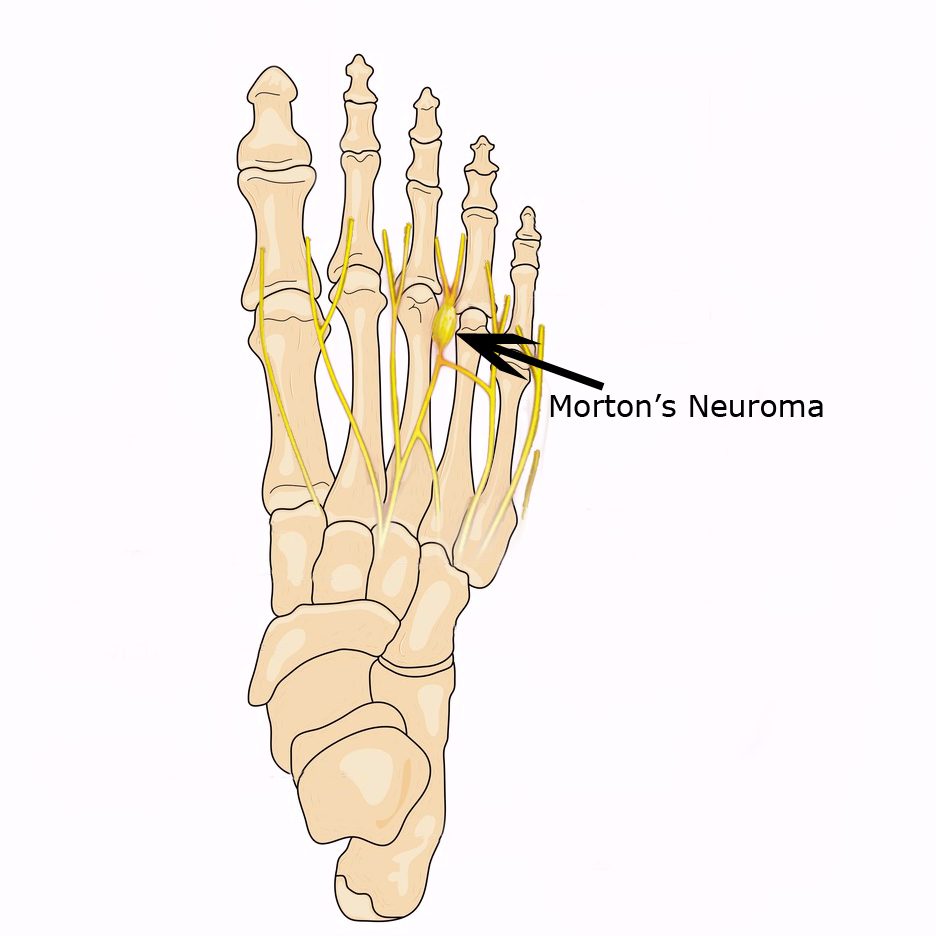
A neuroma is an inflamed, enlarged nerve. Many problems that end in -oma are tumors but this one is not. Neuromas can occur at any nerve in the body but are very common in the foot, which are the ones I will discuss.

Neuromas are most often found in the common metatarsal nerves of the foot which are the nerves just behind the toes. The job of these nerves is to allow you to feel one side of each of the adjacent toe. For example, the metatarsal nerve between the third and fourth toes allows you to feel the sensation on one side of the third toe and the adjacent side of the fourth toe. These nerves do not connect to any muscles, they are just for sensation.

A neuroma forms when the nerve is pressed upon by the adjacent structures. The four surrounding sides of the nerve are made up of: The two metatarsal bones next to the nerve to the left and right. The top border is a ligament connecting and holding together the two adjacent metatarsals called the ‘deep transverse intermetatarsal ligament’. The bottom structure is the skin and the ground below it.

This space defined above is a small place for the nerve to pass along with tendons. Pressure when walking hurts this inflamed nerve. Most people describe the pain as intermittent and ranges from mild to severe. I often hear it described as pain, numbness and tingling that shoots into two toes. Many people describe an uncomfortable fullness between their toes.

People can have neuroma pain in multiple interspaces and in both feet or just one spot. The most common place is between the third and fourth toes and the second most common place is between the second and third toes. Neuromas are very rare in the the first and fourth interespace.

Neuromas between the third and fourth toes are called “Morton’s Neuromas”. Dr. Morton named this neuroma after himself because they are so predominantly found between the third and fourth toes. The reason for this is that the third interspace nerve is naturally larger than the others and is more likely to become inflamed and painful.

People with arches that collapse (pronate) or flat feet are more likely to get neuromas. When the foot pronates and the arch collapses, the foot moves slightly toward the side, toward the little toe. This puts horizontal forces on the metatarsal bones pushing them together.

Women who wear heels are more likely to get neuromas because the high heels tilt the foot forward putting more direct pressure up on the nerve. People who wear tight shoes in the forefoot also get neuromas as the shoes push the metatarsal bones together.

So now that we have described what neuromas are, why we get neuromas and neuroma symptoms, let’s discuss treatment for neuromas.

The first line of treatment is anti-inflammatory measures in order to decrease pain and make the enlarged, inflamed nerve smaller. This first line of treatment includes prescription and over the counter anti-inflammatory pills, icing, and corticosteroid (‘cortisone-like’) injections.

Often, I will give an injection on the first visit. Injections work very well and very quickly to get rid of neuromas. Unfortunately, there are side effects of steroid injections. Usually one injection will not have adverse effects but I have seen it happen. These adverse side effects of steroid injection include local atrophy (weakening) of soft tissues such as ligaments and tendons. Weakening can lead to injury and rupture of these structures. I do not like to give more than three steroid injections in the same spot within twelve months. Other side effects of steroid injections include fat atrophy where a small indent forms between the bones where the injection takes place because the natural fat below the skin atrophies. This can be permanent or temporary. An additional side effect of steroid injections is loss of pigment in the skin. This can happen just in the area of the injection or it can travel along the lymphatic and vein structures causing a streaking effect. This usually only effects people with darker skin and more pigment.

Again, these are side effects that rarely happen but can occur. I discuss these with patients prior to injecting. Due to these potential problems, I try not to perform injections on the first visit and try alternative treatments first. With that said, I do perform these injections regularly on the first visit. I do them when the patients are in severe pain and want quick relief from the pain they are suffering from as the injection is the quickest and one of the most effective ways of getting rid of painful neuromas.

In my experience a majority of the people that are treated with icing and oral anti-inflammatories return for an injection on the subsequent visits.

The next line of treatment involves a longer approach to eliminating the forces that cause neuroma. This is done with custom or over-the-counter orthotics. Sometimes just a pad alone in the shoe can reduce the pressure by pushing the metatarsal bones apart and off the nerve, but a custom orthotic does this as well as addresses the collapsing arch.

When all the above treatments fail, my next treatment is physical therapy. Physical therapist perform anti-inflammatory ‘modalities’ to try to reduce the inflammation of the nerve.

When all the above and PT fail to treat neuromas then we discuss a little more invasive procedures. Surgery for neuromas is the last resort. There are some newer procedures that we call minimally invasive procedures for neuromas. Please do not confuse this with minimally invasive bone surgery of the foot which I discussed in detail of the perils of it, in my previous blog.

There are a few minimally invasive procedures for neuromas:

My favorite procedure is called ‘Radiofrequency Ablation for Neuromas’. I have been doing this amazing procedure for a few years and I have close to one hundred percent success with it. This involves inserting a radiofrequency probe into the foot right at the inflamed nerve. Once it is in the perfect spot, I heat up the tip of the probe to ninety degrees Celsius, just below the boiling point of water. I repeat this process at three areas of the neuroma, all through one entry point through the skin. This pin point spot of heat denatures the proteins off the nerve and stops the transmission of the pain fibers.

Occasionally, there is a result of numbness or decreased sensation in the two adjacent toes, but that is rare and when it does happen, people have always told me that a tiny amount of numbness is better than pain.

Radiofrequency ablation for neuromas is a relatively painless procedure that requires just one or two injections that hurt less than a typical steroid neuroma injection.

Recovery after radiofrequency ablation for neuroma is pretty easy as well. Healing time is very short as there are no incisions to heal. Patients do not need to worry about keeping a foot dry for this reason, and can get it wet and shower immediately after the procedure. Additionally, I only recommend patients stay of their foot the night of the procedure and rest only if there is discomfort for one to two days after. Most people report mild soreness or throbbing for one to two days after. Many people have no discomfort at all afterwards.

After radiofrequency procedures I tell patients that they may see immediate relief of the neuroma pain within one to five days. I also inform them that some people require up to three months for the procedure to work. I do not call it a failure until three months have passed and the pain is still the same as prior to the procedure. When people report no relief at two months, I will repeat the radiofrequency procedure at that point. If they have some relief I tell them to wait a full three months. If they still have some or all of the pain at three months, I repeat it then. I have done one, two and three procedures on people so far and have almost a perfect record.

Other minimally invasive procedures for neuroma include a series of seven to ten sclerosing alcohol injections, cryosurgery for neuromas, and a nerve decompression procedure often called a ‘kobygard’ procedure. I’ve done them all in the past and prefer the radiofrequency over them all. The alcohol injections did not work very well with only a handful of patients having any relief. The cryosurgery procedure worked okay but people had significantly more post procedure pain than radiofrequency and no where close to the success rate. Cryosurgery for neuromas is also done in the hospital or surgery center while radiofrequency is done in my office. Lastly, the kobygard procedure had a better success rate than the cryo or alcohol but not as good as the radiofrequency. Kobygard decompression is also done in the hospital or surgery center and is more invasive requiring a small incision between the toes and suturing. This means you need to keep the foot dry for twelve days after surgery. Patients also experience much more post procedure pain than the radiofrequency as well.

The last option is surgical removal of the neuroma. This is a great procedure when it its needed but as you can tell since I’ve started doing the radiofrequency procedure I have not had to do many open surgeries. This surgery involves an incision on the top of the foot and dissection down to the nerve below the ligament. I then remove the enlarged area of nerve and close up the foot.

When I do these surgeries, the nerve is very enlarged. To give you an analogy of what it looks like, a normal nerve looks like a piece of spaghetti’s thickness. A neuroma looks like the size of a jelly bean attached to the nerve. Depending on the severity it ranges from a Jelly Belly small candy to a traditional large jelly bean in size.

Okay, that’s about it for neuromas today. To summarize, neuromas are enlarged nerves caused by mechanical irritation. They can be very painful and annoying. We’ve discussed conservative, non surgical treatment as well as minimally invasive treatment and finally surgical treatment of neuromas.

As always, I hope this help and feel free to comment. I will do my best to reply in a timely manner.

Dr. Silverberg

What is gout? and… Foot surgery for gout.

Last week I performed surgery on a patient for gout. Well, for a gouty tophus actually. Gout is a metabolic disease that requires pharmacological treatment and diet changes, not surgery.

Surgery is, however, indicated for the symptoms that go along with gout. First I will tell you a little about gout in layman’s terms, then I’ll discuss complications of gout in the foot and finally gout surgery.


What is gout?


Gout is a metabolic disorder in which there is too much uric acid in the blood. This can come from: taking in too much protein that is broken down into uric acid; the kidney not being able to process enough uric acid to excrete it in the urine; and thus uric acid builds up in the blood, or less commonly, the body producing too much uric acid.

Uric acid in the blood comes from the breakdown of purines from our diet. Purines are part of proteins and are more abundant in some foods than others. The biggest offenders are shellfish, organ & red meat and legumes (beans). Alcohol intake competes in the kidney and makes the kidney excrete less uric acid than normal.

Once we intake protein, it is converted to purines and pyrimidines and the purines are further broken down in uric acid and other byproducts. The uric acid is removed from the blood by the kidney. When not enough uric acid is removed, it builds up.

High uric acid alone does not cause symptoms, however, it can effect the kidney. Being a podiatrist, I’ll skip the systemic effects of gout and talk about the manifestations in the foot.

What is an acute gout attack?

An acute gout attack in the foot occurs when the uric acid comes out of the blood and into the joints, usually the great toe joint of the foot.

If you think real hard and try to remember back to high school chemistry, a liquid can only hold some amount of a solid dissolved in it. Once it reaches its saturation point, it cannot hold any more.

Another fact about solids dissolved in liquids is that a warmer liquid can hold more solid dissolved in it than the same liquid when it is cold. Picture dissolving sugar in hot coffee which goes pretty easy, versus trying to dissolve sugar in cold water.

Going back to gout and stop reminiscing about high school, uric acid is the solid and blood is the liquid. When the blood gets further away from our core and into the extremities, it gets cooler. The warmer blood that was holding all of that uric acid dissolved in it can no longer hold all of it. For unknown reasons, the uric acid then comes out of the blood and into the joints as a solid in the form of a solid crystal.

These uric acid crystals are called negative biorefringent crystals because of how they reflect light when looked at under a microscope, but that goes beyond the scope of this article.

When these uric acid crystals enter the joints the fun begins. The body mounts a major immune response as these crystals are not supposed to be in there and are looked at like a foreign body. This is what is called the acute gout attack.

Symptoms of an acute gout attack are usually severe pain in and around the joint. The joint appears angry. It gets red, hot and swollen. Any light touch or motion hurts. Many people tell me that the pain starts at night and just the pressure from the bed sheets hurts.

Often people present with symptoms that mimic an injury but cannot recall any trauma. Often gout is also confused with the red, hot swollen symptoms of infection but there is no open sore or injury where bacteria can get in.

Making the diagnosis of acute gout attack:

Most of the time I diagnose gout based on history and symptoms. Again, red, hot swollen, painful foot joints without history of trauma or infection. Most acute gout attacks occur in the great toe joint and other joints of the foot and ankle. The next most common joint affected is the knee, however, gout can occur in any joint in the body.

Most of the time when I suspect gout, I will do a blood test to measure the serum uric acid, however, this is not always a great test. Often the serum uric acid is normal even during an acute gout attack. When the uric acid blood test is normal you cannot exclude gout as your diagnosis, however, if the serum uric acid is high then you do have your diagnosis. Medically, we call this a false negative when the uric acid is normal but it really is gout. We also say that this blood test “can rule gout in but cannot rule out gout”.

The most accurate way to diagnose gout is to pull fluid out of the painful joint with a rather large needle. I rarely do this because it hurts a lot. Also, the great toe joint is a small joint with very little fluid and it is really hard to get any fluid out of it. When fluid is taken out of the joint, the pathologist looks under a microscope to see if there are uric acid crystals in it. Normally there are none so if he/she sees any, you definitely have gout.

Acute gout attack treatment:

The first line of treatment is anti-inflammatory medications.  The old anti-inflammatory medicine used is Colchicine. Personally, I rarely use colchicine but it is still an acceptable treatment method used today. The reason I don’t use colchicine is because it causes side effects. Patients are told to continue the colchicine until either they vomit or have diarrhea, whichever comes first. Both not very pleasant sequelae.

Instead of colchicine, I use Indomethacin (aka Indocin). Indomethacin is in the same class of drugs as aspirin or Motrin but is stronger. For unknown reasons it works better on gout attacks than other anti-inflammatory drugs in the same class. Other anti-inflammatory drugs work well too, but I find Indomethacin to work the best. I prescribe Indomethacin 50mg, one by mouth three times a day for the first 4-5 days, then twice a day for up to 7-8 days. It is taken with food. I tell patients to stop it when the pain subsides or they reach 7-8 days and then follow up.

When people cannot tolerate Indomethacin because of stomach problems, I usually prescribe Celebrex. Celebrex is in a class of anti-inflammatory drugs called Cox-2 inhibiters. These drugs have less adverse effects on the stomach.

Another treatment is steroid injection into the joint. I do this when the symptoms are really severe. The steroid injection is a very strong anti-inflammatory, placed exactly where the inflammation is. It works almost immediately usually to resolve the pain. Unfortunately, it hurts going in. I have to stick a needle into an already painful, inflamed joint.

Oral steroids also work well but have more side effects than the Indomethacin. Icing the painful area will help as well. Resting the effected joint with decrease pain too.

Long term treatment involves oral medications to prevent the build up of uric acid in the blood. Again, as a podiatrist, I will skip this as it exceeds the scope of my blog post. One thing I will write about this is, do not take these uric acid lowering medicines while in the acute stages of gout as they often make the gouty attack worse.

Below are pictures of the gouty tophus that I took out. This is the result of many years of build up of uric acid in and around a joint.

Thanks for reading and I hope I’ve helped. The subject of gout is huge and I could have written many times as much as this already long post…

Below are two pre-operative pictures of gout (click any picture to enlarge):

photo04photo06

Below are intra-op pictures of the gouty tophus coming out:

photo09photo10

And finally below is a picture of the gout tophus once it was removed from the foot:

photo11

And, lastly, below is a picture from a different surgery. This is a picture of uric acid crystals, gouty tophus, I encountered when doing bunion surgery. I did not expect to see this as they patient never had a history of any gout attacks, however, apparently, he had chronic gout and did not know it.

DSCN2888

Lawrence

The best topical medicine for nail fungus. NailPure by Dr. Silverberg

I’m very proud to announce that my new topical medicine for nail fungus is finally being produced.

After over eighteen months of working with my chemists to formulate the product and trials on patients, the final product was delivered recently.

My new nail fungus topical medication is called NailPure by Dr. Silverberg (Click for more info and to purchase online).

The main ingredient, Tolnaftate, has been around for decades for the treatment of dermtophytes (fungus that live on skin, nails and hair). The unique thing about NailPure is the vehicle that allows the Tolnaftate to penetrate into the nail. This multiple oil vehicle is what makes NailPure so special and the best topical anti fungal on the market.

The term vehicle, when used to describe mediations reefers to the inactive ingredients that allows the medication to be delivered to the site where it is needed. In this case, the primary ingredients in the vehicle are jojoba oil, tea tree oil and manuka tree oil. There are also other oils in the vehicle but these three are the most important.

I’ll describe each of these three oils here but if you want more information about the rest of them, see www.NailPure.com

Jojoba oil is the most plentiful ingredient of the oils. The chemical structure of this oil allows it to move between the keratin cells that make up the hard nail plate. This allows the tolnaftate, which is emulsified in it, to also penetrate the nail, delivering it in the nail where the fungus resides instead of just depositing it on the nail surface like other topical antifungals.

The next most plentiful oil is tea tree oil. Tea tree oil also helps the tolnaftate to penetrate into the nail in the same manner as jojoba oil, but it also has its own anti fungal properties. Natural tea tree oil has been used for centuries (at least) for treatment of infections, long before modern medicine has been around.  In my eleven years of private practice podiatry in NYC I have see many patients have improved their nail fungus using tea tree oil. In fact, I always say that tea tree oil is best ‘home remedy’ for nail fungus.

The next natural oil in NailPure is Manuka tree oil. I’ll admit I had never heard of manuka tree oil until I started doing research to produce my own topical nail fungus treatment. Like tea tree oil, Manuka tree oil comes from a small tree in Australia. And, like tea tree oil, manuka tree oil has been used by locals for centuries in the treatment of infections. In studies manuka tree oil was found to be more than ten times more potent and effective than tea tree oil treatment.

The last ingredient I’ll tell you about today is one that is neither anti fungal nor part of the vehicle. It’s acetic acid, aka ethanoic acid. Acetic acid may sound familiar to you. Acetic acid is the main ingredient in vinegar. It is what gives vinegar its characteristic smell and taste. Why would I put ‘salad dressing’ in my new topical anti fungal? hold on to that question for one more moment.

One of the home remedies that I hear patients tell me about often is soaking your feet in vinegar for nail fungus. I’m sorry to report that this alone will not cure your nail fungus, however, acetic acid does have one property that is advantageous in the treatment of nail fungus.

Acetic acid acts is a natural whitener of nails. That’s right, it can actually cause the nail to look more white and clear. One of the symptoms of nail fungus is yellowing, darkening, clouding and discoloration of nails.

As one of ingredients in NailPure, acetic acid helps with the discoloration of nails. I’ve found that this is the first thing patients report back to me when staring NailPure. Their nails actually start to look better long before the fungus is being killed. I find this helps in patient compliance and continued application of the product as patients are excited to start seeing improvement, and excited to continue to use the product. Acetic acid use in antifungal medicine is a unique characteristic of NailPure when compared to other topical antifungals.

That’s enough writing about the fabulous ingredients in NailPure, now let me tell you about the exciting results I’ve been seeing.

As I indicated above, I have been using NailPure on my patients for about a year and half. For the fist six months, the first few formulas we tried worked well, but not quite as good as the more recent ones over the past year. Finally, I found the combination of ingredients and ratios that produced great results. This is the final secret formula that makes up new NailPure!

Although the acetic in NailPure works very quickly to start whitening the nail, the true anti fungal effect takes many months to work. This is because it is dependent on the new nail growing in clear and pushing out the old infected nail as it grows. This process is dependent on how fast individuals nails grow, but is usually six to twelve months for the toenails and six to nine months for the fingernails.

Additionally, I now always combine NailPure with my laser nail fungus treatments and oral medications for nail fungus.

Try NailPure today!


Celebrity Podiatrist

Best podiatrist New York City is now Best podiatrist in Los Angeles, at least for a few celebrities…

I am happy and proud to announce that my humble New York City Podiatry Group is sought after from people from all over the country.

Recently, myself and my associate doctors, have treated and operated on a number of celebrity patients. Obviously, I cannot disclose names but I’ll tell you we’ve treated a number of television stars, movie stars, talk show stars, radio stars, and news reporters; both on air and behind the scenes.

Best Podiatrist Los Angeles Celebrity Podiatrist 01While it is exciting to be a ‘Celebrity Podiatrist’, we treat all of our patients like celebrities and with respect. We appreciate the trust they put in us.

Almost daily I get podiatry questions from this blog, from people all over the world. Many people book travel to NYC in order for me to treat them and operate on them. I often do surgery on people who spend three to four weeks here in NYC recovering.

In the past decade of practice (actually over 12 years) I have treated many ‘high profile’ patients including: actors and actresses, reporters, celebrities, scientists, inventors, diplomats, radio personalities, professional and amateur athletes, professional wrestlers, CEOs, other doctors, attorneys, authors and many other interesting people.

My current patients will agree that I get to know my patients. I pride myself on being knowledgeable about many subjects. I often talk about many personal matters with my patients during their podiatric visits. I really enjoy getting to know people and learning from them.

My brother and I always joke about how different out medical practices are. My brother is an emergency medicine doctor at a large level one trauma center in Brooklyn. A very different environment than my fancy Madison Avenue office. He fixes people, and sends them out on their way and usually never sees them again. I, on the other hand, enjoy getting to know my patients and often build a long lasting relationship with them. I really enjoy this part of my practice.

Thank you to all my current patients for making my practice successful, and I look forward to meeting the rest of you.

Lawrence Silverberg

British Hammertoes are “Wonky Toes”!

A few weeks ago a lovely young woman came in to my office. She sat down with me in my exam room and proceeded to tell me in a wonderful British accent that her complaint was "Wonky toes".

I guessed that she meant hammertoes but I wanted to clarify this before proceeding. I had never heard the term Wonky with or without toes after it.  I asked her to clarify what she meant by wonky toes and she said, "you know like wonky teeth, crooked toes, crooked teeth."

We had a good laugh and I had learned a new term. I asked her if I could blog about her and she agreed (obviously, as you *are* reading this).

My guess is that this post will be at the top of the search engines for wonky toes as I bet no one else is writing about wonky toes (at least in the US).

Fixing “Wonky Toes” – Wonky-Hammertoe Surgery.

My lovely patient had surgery yesterday for the diagnosis of hammertoe syndrome to correct two hammertoes. British translation: (read aloud in your best British accent) “This patient had surgery yesterday to correct two wonky toes in order to resolve her wonky toe syndrome.”

Pictures of her wonky toes are below. I’ll get the before and after hammertoe surgery pictures posted in a few months.

This picture (click to enlarge) shows the hammertoes of the fourth and fifth toes. The fourth toe is contracted down and under the third toe. The fifth toe is also contracted and rotated.


This is a picture of the same foot (click to enlarge) taken from another angle. You can see the third toe is elevated off the ground from the fourth toe residing underneath it. You can also see the fifth toenail is rotated forty five degrees relative to the ground.


I will be posting postoperative hammertoe surgery pictures soon…

I love when people post comments so please do not be shy. I will also personally answer all questions presented.

Thanks for reading, Lawrence.

Ethical laser nail fungus treatment (and topical treatment for nail separation)

This week I turned down three patients for laser nail fungus treatment. That’s right, I told three people NOT to pay me $600 each, $1800!

All three had separation of the nail form the nail bed soft tissue attachment. This causes the nail to look different in color in the area that it is separated.

This discoloration of the nail looks like nail fungus to the untrained eye. Very often, people come to my office with this separation of the nail from the nail bed, thinking it is fungus when it is not!

Laser will not fix this problem. Neither will topical medicines alone.

Treatment for separation of nails:

The only fix for this is to remove the part of the nail that is separated, all the way back to the area of good soft tissue attachment with cutting and grinding of the nail.

Once this removal is performed, then I advise patients to use topical medicine for the nails. I have formulated my own topical medicine for this purpose. This medicine also has an anti fungal medicine in it.

My product is called NailPure by Dr. Silverberg. The anti fungal ingredient is Tolnaftate. The multiple oil vehicle allows the Tolnaftate to penetrate the hard nail plate to reach the fungus.
In the case of nail plate separation, however, it’s not the anti fungal that is important. It is the multiple oil vehicle. It contains tea tree oil, manuka tree oil, jojoba oil, sunflower seed oil, and sweet almond oil (and vitamin E). This unique combination of essential oils penetrate, emulsify, soften and hydrate the nail and surrounding skin. Additionally, NailPure contains acetic acid that whitens the nail to make it appear more normal very quickly. Acetic acid is a natural acid that makes vinegar have its characteristic smell and taste.

By treating the skin and nail, NailPure allows the nail to grow in and reattach to the nail bed having normal color and looking healthy.

The best topical antifungal for nails also works on nail bed separation:

Wow, what a tangent! I was talking about doing the right thing for these three patients, and got excited about introducing my new topical nail fungus treatment. I spent one and a half years working with my chemist in Florida to perfect NailPure. I tried many different combinations of ingredients and vehicles until I came up with the proper formula. I tested it on dozens of my patients and waited patiently while their nails grew in healthier without fungus, whiter, thinner, and more clear. I then discovered how well it worked for nails that were separated from the nail bed. I used to use topical urea gel or cream for these patients but I discovered that NailPure worked so much better.

Honestly, when I started developing NailPure, I did not think to use if for nail separation, but when I discovered how well the oil vehicle worked on the nail and skin, it was obvious. I had stumbled upon a new, amazing treatment for a previously very difficult problem to solve.

Going back to my original topic, these three patients were very grateful that I saved them *$531 by not performing the laser for nail fungus, that would have been unsuccessful. *Note: $600 minus $69 for the NailPure.

Unfortunately, many doctors as not as honest, ethical and altruistic as I am. They would have performed the laser nail fungus treatment for the money. You see, studies have shown the laser nail fungus treatment to be 70-80% effective. These doctors hide behind that statistic and tell these people that is why the laser did not work.

Other doctors may be mistaken to make an improper diagnosis of nail fungus when in fact it is separation of the nail plate. In my opinion, this is why many nail fungus treatments fail. It was never fungus.

Choosing a provider for Laser Nail Fungus Treatment:

In summary, when choosing a provider to take care of your nail fungus, make sure you go to a doctor that you know and trust. Get a recommendation from a friend or another doctor (or come to NYC to my practice). Question your doctor about if it is really nail fungus or separation of the nail plate. When in doubt, your doctor will send a (painless) clipping to the lab for evaluation under the microscope. And lastly, be weary of doctors advertising for laser nail fungus treatments. A doctor spending money on advertising will be looking for return on investment and willing to perform lasers on everyone that comes through the door inquiring. Keep in mind too, that the lasers are very expense pieces of equipment and doctors will be looking to pay off their leases… However, with all at said, most doctors are still ethical. There are just a few that are not to look out for.

As always, feel free to send me email questions on this topic. Dr. Silverberg

Hammertoe Surgery

pain in heels

Hammertoe anatomyMany people seek the help of their doctor in hopes of fixing their hammertoes. It is common for podiatrists to receive patients who want to do something about their “ugly toes.” In truth, hammertoes can also be quite uncomfortable when they lead to such thing as painful corns, calluses, and swelling. The good news is that we will be able to perform toe surgery if necessary.

Depending on what stage the deformity is in, a hammertoe can be either flexible or rigid. When they become painful hammertoe surgery will be necessary to alleviate the problem.

Different Types of Hammertoe Surgery

Hammertoe contractureSurgeries to correct hammertoes do not require an overnight stay at a hospital. The procedure can be done during the day and then you can go home to recover. Essentially, you are given either just a local anesthetic or sedation so that you can sleep through the procedure. Such surgery only requires a small incision. The different types of hammertoe surgery are soft tissue correction, digital arthroplasty (removal of a small piece of bone), and digital arthrodesis (joint fusion).Painful hammertoes surgery

Soft tissue corrective surgery redirects the tendons and joint capsule of your toe which will correct the position.

A physician will have to implement a combination of procedures using techniques from the different types of toe surgeries mentioned. Digital arthroplasty involves correcting the soft tissue and removing a piece of bone in order to straighten the toe. Digital arthrodesis techniques involved fusing two bones together in order to straighten the toe. Often hammertoe surgery requires a mental wire or other implant to be inserted into the toe that will hold it into place while it heals. The end result will be a straightened toe.

How Long Does it Take to Recover from Hammertoe Surgery?

I do most of my surgeries on Friday. I instructed patient to remain off their feet all day Friday, Saturday and Sunday. People that have a desk job can usually return to work on the Monday following their Friday surgery. Most people wear a surgical shoe for 3-4 weeks.

Before surgery, make sure that you have a friend or family member who can bring you home after the procedure. It’s important that you take proper care of your feet in the weeks following the procedure in order to get the most out of your surgery. This will involve wearing proper footwear and following the instructions given.

Common misconceptions about foot surgery

While I was writing my last post on hammertoe surgery it occurred to me to write a post on common misconceptions of foot surgery.

(Don’t feel like reading a long post? Skip to the last paragraph for a quick summary.)

1) The first one was one that I mentioned in my last post: that extra skin left behind in surgery reabsorbs. This is preached by many foot surgeons but is entirely untrue. Skin left behind remains extra skin after the swelling and scar tissue go down. It is true in the short term that you may not notice it because the area is swollen and the skin is expanded but once the size of the area goes down you still have extra skin.

A small exception to this is when we do hammertoe surgery for corns, sometimes we have to leave part of the corn behind because the skin incision would be too large to close if we cut out the whole corn. After the hammertoe surgery, the pressure and rubbing on the shoe that caused the corn is gone. In this case, the thick hard skin that makes up the corn will go away after surgery. However, this assumes that the correct amount of skin was removed, including the corn. If extra skin remains at the incision, even though the hard part will go away, the extra skin will not go away.

2) The next misconception is also somewhat of a cosmetic one. Many foot surgeons say they put the incision for bunion surgery on the top of the foot because if they put it on the side where it is hidden more, it will rub on the shoe and cause discomfort. Last time I looked at a shoe it encountered the foot on four sides not just one. The real reason doctors put the incision on the top of the foot for bunion surgery is just because they were taught that way when they learned surgery. It also makes it slightly easier to do the surgery, so the surgeon can more easily access the side of the great toe joint closer to the second toe in order to release the soft tissue contracture there. This creates an unsightly scar when looking down on the foot. A much more cosmetic way to do it, is to put the incision on the side of the foot so when looking down you don’t see the scar. With some finesse, I can still easily access the other side of the joint and if I need even more access, I can make a tiny incision between the first and second toe that is barely noticeable.

3) The next misconception: minimally invasive bunion surgery (or other minimally invasive foot surgery) is superior to regular open surgery. The truth is quite the opposite! Minimally invasive surgery entails using a small drill to cut the bones through small stab incisions while visualizing the drills under real time x-rays (Fluoroscopy). This type of surgery is very imprecise as to how much bone is removed and where the cuts are made. I have seen many of these patients have complications due to taking out too much bone and shortening the metatarsal too much, or even not taking enough bone. In addition it is impossible to fixate the cut bone with screws in order to get the bone to heal in the proper place. Some of the doctors that do this type of surgery use ‘percutaneous pins’ in order to hold the bone. This means the pins go through the skin and into the bone. The pin remains sticking out of the skin for 4 to 6 weeks after surgery in order for the bone to heal. The downside to this is that you need to keep the foot dry the whole time the pin is sticking out. Also, the pin exit point creates an additional scar. Additionally, as long as the pin sticks out through the skin, a patient may get a "pin tract infection". This is when the bacteria from outside the body goes down the pin and into the foot, and into the bone. When you get bacteria or infection in the bone you have a serious problem and need the bone removed, the use of IV antibiotics and usually requires hospitalization. When a screw is used it is completely inside the foot and a patient may get the foot wet after about one and a half to two weeks. Most doctors that perform minimally invasive surgery tell their patients that they will be back to wearing shoes and back to activity faster than traditional open surgery. This is usually not true as they recovery in a similar amount of time.

4) Next misconception: if your doctor tells you that you’ll be back to normal shoes and normal activity in anything less than three or four weeks when he/she is doing bone surgery (and mostly any other foot surgery), he/she is lying to you. It takes 4 to 6 weeks for bones to heal and be strong after they are cut during surgery (or when they are fractured in an injury). After bone surgery, the patient should be immobilized in a boot or a surgical shoe for this 4 to 6 week period in order to allow the bones to heal properly. Occasionally, people wear a brace for only 3 weeks, but that is more unusual, as almost all of my patients wear it for 4 weeks. Whenever bones are cut, and with any other surgeries, there will be scar tissue that forms in the operative site. The doctor will call this “induration”. This induration will be present for 3-6 months and many times up to a year. During this time, the surgical site will feel hard and stiff. Your doctor may prescribe physical therapy after surgery to break up some of these adhesions. All surgeries produce this scar tissue. It does not mean that you will not be able to perform activities or not wear shoes, but I tell my patients that this will be present and they will not be able to wear all shoes or perform all activities due to it.

5) The last misconception that I hear patients talk about is that foot surgery is extremely painful and even more painful than other types of surgery. The truth is that foot surgery is unique compared to surgery on other parts of the body because you have to walk on your foot postoperatively. This weight bearing and not elevating the part of the body does cause slightly increased pain and throbbing. There are surgical techniques that I employ in order to reduce the amount of pain postoperatively. The amount of pain that patients experience starts with how the surgeon handles the tissue during the surgery. In my residency I was fortunate to work with plastic surgeons that taught me unique tissue handling skills that reduce postoperative pain and swelling. Most of my patients experience moderate to no pain after surgery. While I cannot guarantee that for everyone, I invite potential patients to read my reviews in Google. Many of them state that they had little to no pain, or experience less pain than they expected to have after foot surgery. Additionally, I often prescribe a cold therapy device to be used postoperatively. I also prescribed painkillers that reduce the discomfort after surgery greatly. Most people only take these for 1-3 days after surgery. Having less pain really enhances the surgical experience and lets patients return to more normal activities sooner. For example, most of my patients that have desk jobs are able to go back to work on Monday after doing surgery on Friday.

As you can see, there are many misconceptions about foot surgery. I have generalized my descriptions, however, many variables will affect each individual patient. When patients come in for their preoperative appointment, I am very thorough and go over the following: Alternatives to surgery, risk versus reward of surgery, benefits of surgery, pre-operative planning, postoperative course, potential for further surgery in the future, preventative care against recurrence of the deformity, and any other unique characteristics for the individual patient. I will answer all of your questions and make you feel comfortable about having surgery prior to moving forward with the actual surgery.

To summarize the most important points of this blog: 1) Don’t do minimally invasive surgery. (Yes, it is THAT bad that I can generalize). 2) There are ways to reduce postoperative pain. 3) Have realistic expectations about recovery. 4) There are ways to reduce surgical scarring. 5) There are surgical techniques to make foot surgery more cosmetic while getting rid of painful foot deformities.


The Best Hammertoe Surgeon and Why

In my residency training I was very lucky to have a good friend who was a plastic surgery fellow. (Fellowship comes after residency in a doctor’s training, and is very specialized.) My friend taught me various plastic surgery procedures and tricks that I have applied to my foot surgery.

For example:

When surgeons do hammertoe surgery, part of one of the toe bones is removed in order to straighten out the toe. When the bone is removed, the toe is shortened, which is one of the goals of the procedure in order to reduce the contracture of the hammered toe.

When the bone is shortened, the skin length stays the same.  As a result of this, there is bunching up of the skin.  As an analogy, picture wearing a knitted glove that is too large for your hand. When you push the glove on to touch the tip of your finger, the excess material will be bunched up and folded.

Most doctors remove the part of the skin directly under the incision in order to shorten it however, they leave the excess skin on the other three sides of the toe and try to just suture it down, but inevitably, there is excess skin left over that will always be there at the edges of the incision. I’ve heard so many doctors in my training and in practice say that the skin just “reabsorbs”.  This is not true, but they just don’t know how to fix this problem.

Enter my friend the plastic surgeon… He taught me how to do this complex but tiny procedure called the skin plasty. Through a series of diagonal cuts, triangles, and diamonds, I can reshape the excess skin into a round toe again. This involves using straight incisions at angles to one another that remove the excess skin and create a round toe.

I employ these skin plasty procedures in every surgery I do in order to create a more cosmetic outcome while fixing the foot deformity but in hammertoe surgery they are the most important.

In addition, he taught me a variety of other tricks to get the most cosmetic result while fixing the underlying orthopedic problem and relieving foot pain like just a few that I have listed below:

  • The first technique is simply incision planning. Where you place in incision is very important and differs from patient to patient.
  • The technique of suturing makes a huge difference in the appearance of scars. Both the skin suturing and the suture closure of deeper layers.
  • Tissue handling techniques makes a big difference in reducing postoperative pain and reducing postoperative swelling. This includes which instruments the doctor uses during the surgery.
  • Bandaging techniques even make a small difference.

My friend allowed me to scrub cases with him doing breast augmentations, tummy tucks, face lifts and many other plastic surgery procedures. I think of him every Friday when I perform foot surgery, and am thankful that he taught me how to be a better surgeon.

Below are before and after pictures of hammertoe surgery (click any picture to make larger):

BELOW: Pre-operative photo of foot with third digit hammertoe and corn.

image

BELOW: Post-operative photo of hammertoe surgery at five days.

image

BELOW: Post-operative photo of hammertoe surgery at only four months.

image

© Copyright 2010 Best Podiatrist NYC
Lawrence Silverberg, DPM
City Footcare, PC
130 E 35th Street New York, NY 10016
212-871-0800
www.cityfootcare.com
cityfootcare@gmail.com
Specializing in foot surgery, bunion surgery, hammertoe surgery, cosmetic foot surgery, general podiatric surgery.

What are Hammertoes? Prevention and Hammertoe Surgery.

Allow me to share some information in layman’s terms on hammertoes and  Hammertoe surgery. The four small toes on the foot are similar in composition to the fingers. Each of the small toes has three bones with joints in between. The toes form a joint,image meeting in what is called the ball of the foot. These bones in imagethe small toes are normally straight, but when they become bent (at the first joint), it results in hammertoe. Hammertoe can occur in any of these small toes. Usually, the bend also causes a growth similar to a deep blister, called a bursa. This bursa can become inflamed and eventually, hard callusing and corns can occur.

At the beginning of the deformity, the toe can be straightened. With time, however, the joints become rigid. This can then affect the joint at the ball of the foot and, sometimes causing the joint capsule to tear. The joint is then dislocated and the toe points upward. Painful hammertoes require attention before the condition worsens.

What are the causes of hammertoe?

  • Improper footwear, especially in women who wear high heels or ill-fitting shoes521049
  • Improper function of the foot itself during walking
  • Trauma or injury to the foot either from a direct blow or overuse
  • Diabetes or rheumatoid arthritis can predispose a person to hammertoe

What are the some symptoms of hammertoe?

  • Prominence or deformity of a toe accompanied by pain
  • Redness around the painful joints
  • Swelling around the afflicted joints
  • Corns on toes 
  • Calluses on toes
  • Difficulty wearing shoes, from painful toes which may also be deformed image
  • Difficulty walking
  • Stiffness in the toe joints

An examination by a qualified podiatrist, a medical history and X-rays to determine the extent of the damage and arthritis in the joint are usually required to make the proper diagnosis. Simply having ugly toes isn’t a reason to naturally assume that you have hammertoe unless the “ugliness” is accompanied by the symptoms listed above.

Is there anything you can do to help alleviate the pain?

  • You can wear proper fitting shoes with a large toe area
  • You should avoid wearing high heels
  • You can wear a protective pad over the toe(s) that cause the problem
  • You can visit a qualified podiatrist for an assessment and imagetreatment. The podiatrist can imagerecommend the proper footwear, suggest some exercises if you can still move your toes, teach you how to strap your toe in the correct position, supply you with a splint or padding, assess whether you should consider wearing orthotics or advise you whether you should have surgery.

Without proper treatment, the hammertoe deformity will become worse and eventually the afflicted toe(s) will become completely stiff and cause severe problems with footwear. Because of the toes being displaced, the ball of the foot will get undue stress, building up corns and calluses, causing a great deal of pain. So, you may be asking yourself what you can do if you begin to develop hammertoe. In the short-term, you can do things to alleviate the pain and discomfort, but in the long-run the only way to rectify the situation is with hammertoe surgery.

© Copyright 2010 Best Podiatrist NYC
Lawrence Silverberg, DPM
City Footcare, PC
130 E 35th Street New York, NY 10016
212-871-0800
www.cityfootcare.com
cityfootcare@gmail.com
Specializing in foot surgery, bunion surgery, hammertoe surgery, cosmetic foot surgery, general podiatric surgery.

Keep your foot dry after surgery!

image

After foot surgery it is important to keep your foot dry. Depending on the procedure it is usually between two and four weeks.

As a convenience for my patients, I dispense a device to keep the foot dry. It works very well in the shower. (click picture to enlarge)

Today, a patient came in and showed me a new use for the shower bag! We received over a foot snow in New York City this week. In order to keep her foot dry after surgery she used her shower bag with her fracture brace to come in for her post-operative appointment.

I thought this was a great idea and thought I would share it. See the pictures below.

imageimageimage

image

cross-posted at: Best Foot Surgeon NYC

© Copyright 2010 Best Podiatrist NYC
Lawrence Silverberg, DPM
City Footcare, PC
130 E 35th Street New York, NY 10016
212-871-0800
www.cityfootcare.com
cityfootcare@gmail.com
Specializing in foot surgery, bunion surgery, hammertoe surgery, cosmetic foot surgery, general podiatric surgery.

Case Study: severe bunion surgery opening base wedge osteotomy

I am going to start posting quick case studies of interesting foot surgery and other foot problems as they come in. These posts will be shorter than my more education posts and just present the complaint, physical findings, diagnosis and treatment.

The first case study is a severe bunion. This is one of the largest bunions I’ve operated on in my ten years of practice (since 2000).

This patient had severe pain in both of her feet with bunions. The right bunion was bad but the left bunion was really severe.

Here are preoperative pictures. (Click any picture make larger.)

imageimageimage

You can clearly see the great toe is under the second toe and how large her bunion is.

Below are the pre-operative x-rays:

image

You can clearly see the large bunion with the first metatarsal severely angulated.

I decided to do an opening base wedge osteotomy (inserting bone graft to move the metatarsal) . Her first metatarsal was a bit short and if I had done a closing osteotomy (taking out bone to move the metatarsal) it would have shortened it even more, so I didn’t do the closing wedge surgery. After I did the base wedge osteotomy I released the soft tissue contractures at the great toe joint.  Then I removed the bump of bone at the first metatarsal joint. Then I did an Akin osteotomy in the toe bone because the first toe was still turned toward the second toe. Then I corrected for the extra skin after moving the bones. After all of these procedures the correction was amazing.  There was a new foot!  See below.

I called the patient the night of surgery and again the next day and she reported that she had little to no pain even with all the work that I did!

I did surgery two days ago so I don’t have and long term postoperative pictures yet but I did have one of the OR nurses take a picture while still on the operating table at the end of the surgery. I also have immediate postoperative fluoroscopy pictures.

Below are the before and after pictures of this bunion surgery: I will add more long term pictures in the future.

imageimage

imageimage

Come back in the future to see pictures of the healing process. I will update below…

© Copyright 2010
Best Podiatrist NYC
Lawrence Silverberg, DPM
City Footcare, PC
130 E 35th Street
New York, NY 10016
212-871-0800
www.cityfootcare.com
cityfootcare@gmail.com
Specializing in foot surgery, bunion surgery, hammertoe surgery, cosmetic foot surgery, general podiatric surgery.

Bunion Surgery NYC – Video that explains bunion surgery in layman’s terms.

Hi again, I’ve been busy working on two blog posts.  One is now done and one is almost done.  Today I will post one of them:

I’m proud of this project.  Below is a link (click on the picture) to a video I made that cleverly explains bunion surgery in layman’s terms.  I took part of my usual bunion pain consultation dialog that I have with my patients every day and made a video explaining bunion surgery.

I figure, by making a video about bunion surgery it will be much less dry than reading all about bunion surgery.  With that said, the other post I’m working on is a written description of bunion surgery including before and after pictures.

So, click the picture below and enjoy a virtual preoperative consultation on bunion pain and bunion surgery including alternative, conservative choices for bunion pain.  Get the popcorn for a riveting eight minutes…

image

© Copyright 2010
Best Podiatrist NYC
Lawrence Silverberg, DPM
City Footcare, PC
130 E 35th Street
New York, NY 10016
212-871-0800
www.cityfootcare.com
cityfootcare@gmail.com
Specializing in foot surgery, bunion surgery, hammertoe surgery, cosmetic foot surgery, general podiatric surgery.

Congenital duplication of digit, webbed toes, Six toes or four toes, you decide

I had a very nice young lady come in with a complaint of bunion pain.

The interesting part of this case though, is not the bunion but a congenital abnormality she had.  She had webbing of her second and third toe with duplication of parts of the second toe.  What does this mean?  I think the pictures will explain it much better than words, see below: (click any picture to enlarge)

image

Above, you can see the bunion and the congenital abnormality.  There are two nails on the second digit and webbing of the skin between the second and third digit.  When you see two separate nails you can assume there is duplication of the distal bones as well because the nails are attached to the distal phalanx bones.

image

In the above x-ray you can see the normal bones of the third toe with three bones, the proximal phalanx, middle phalanx and distal phalanx.  You can see the bunion.  You can see the two distal phalanx bones and the middle phalanx have all fused into one large bone of the second digit.

Having extra toes (or fingers) is called polydactyl.  It is a congenital anomaly and can be hereditary (runs in families) but not always.  Treatment depends on the presentation and is usually optional.  If there are concerns from the parents of future disability or shoe fitting problems surgery is often performed as an infant.  Surgery also depends on which toe is duplicated.  In the above patient, surgery would rarely be performed due to difficulties making the toes look normal.  The nails are virtually impossible to combine.  I’ve done surgery to remove the webbing of the toes using skin flaps and skin grafts.  Surgery is much more often performed when there is duplication of the first or fifth digit which tend to make fitting shoes difficult and have an excellent cosmetic prognosis.

© Copyright 2010
Best Podiatrist NYC
Lawrence Silverberg, DPM
City Footcare, PC
130 E 35th Street
New York, NY 10016
212-871-0800
www.cityfootcare.com
cityfootcare@gmail.com
Specializing in foot surgery, bunion surgery, hammertoe surgery, cosmetic foot surgery, general podiatric surgery.

Foot Trauma, fracture of the interphalangeal joint of the great toe:

Today I’d like to tell you about a foot trauma case. A young lady presented to my office with a chief complaint of pain in her right great toe. She stated that two days prior she fell off her bicycle. She said the pain was not terrible however when she looked at her foot her great toe was bent at 90° at the joint in a direction where it usually does not go. She quickly grabbed the toe and popped it back into place. She then had increased pain. She says that the toe swelled up immediately after her fall.

Physical examination revealed an extremely swollen and bruised right great toe with severe pain to palpation. I checked to make sure there was good blood flow by pressing on the distal aspect of the toe and noted that the color blanched and came back within 3 seconds.  She also had normal feeling in the tip of the toe indicating that there was no nerve injury.

Her x-ray (seen below) showed a mildly displaced fracture of the distal phalanx of the great toe. She did an excellent job at putting the toe back into position from the dislocated joint. This joint, is called the interphalangeal joint. (Intra-articular, mildy displaced fracture of distal phalanx of hallux) (click and any picture to enlarge)

image

Treatment: I immobilized her in a fracture brace that she will wear for 4-6 weeks. Had she not reduced the dislocation I would have given her local  anesthesia and popped it back into place in my office. I advised her that since the fracture enters the joint that she may experience osteoarthritis in this joint at some time in the future.

When a fracture enters the joint it disrupts the cartilage on the end of the bone. When you having injury to the cartilage over time it may wear away and cause arthritis such that the two bones grind together. If this is the case, she will most likely require surgical intervention. In that case what I do is remove the cartilage completely from both bones and fuse the joint with a screw. When the two bones heal they become one bone. When people have arthritis joint fusions are very often used to alleviate the pain. In theory, if there is no motion at the joint then there is no pain at the joint.

The below picture is not of this patient, however, this is what a joint fusion (arthrodesis) with headless screw of the interphalangeal joint looks like:

image

© Copyright 2010
Best Podiatrist NYC
Lawrence Silverberg, DPM
City Footcare, PC
130 E 35th Street
New York, NY 10016
212-871-0800
www.cityfootcare.com
cityfootcare@gmail.com
Specializing in foot surgery, bunion surgery, hammertoe surgery, cosmetic foot surgery, general podiatric surgery.

Painful Tailor’s bunion, surgical correction of Tailor’s bunion.

Today a young lady came in with a complaint of a large bump behind her fifth toe and added that her fifth toe is turning under her fourth.  She has pain when she runs and works out.  This has been getting progressively worse over the past six months.

I diagnosed her with a Tailor’s Bunion (also called a Bunionette).  See picture below: (click any picture to enlarge)

image

Tailor’s bunion is a prominence of the fifth metatarsal bone at the base of the little toe. The deformity received its name because tailors sat cross-legged all day with the outside edge of their feet rubbing on the ground. This constant rubbing led to a painful bump at the base of the little toe.

Usually a tailor’s bunion is caused by an inherited faulty mechanical structure of the foot. In these cases, changes occur in the foot’s bony framework, resulting in the development of an enlargement. The fifth metatarsal bone starts to protrude outward, while the little toe moves inward. This shift creates a bump on the outside of the foot that becomes irritated whenever a shoe presses against it.  Sometimes a tailor’s bunion is actually a bony spur (an outgrowth of bone) on the side of the fifth metatarsal head.

In the case of this patient, the fifth metatarsal bone was angulated toward the outside.

Treatment for tailor’s bunion:  I informed her all about the surgical correction of Tailor’s Bunion where I make a small incision On the side of the foot and access the bone.  I then cut a small wedge in the bone to change the angle toward the inside of the foot. After the bone wedge is removed, I placed a tiny titanium screw in order to hold it in place to heal.

Recovery from tailor’s bunion surgery: For people with a desk job I can do the surgery on a Friday and send them back to work on Monday in a surgical shoe or boot. This patient, however, has a job in which she is on her feet doing sales. I advised her that she would need to take 2-3 weeks off of work or work at a desk if possible.  She chose to wait until the Fall to perform her surgery when her work schedule is lighter and she can work in the office, rather than on her feet doing sales calls.

© Copyright 2010
Best Podiatrist NYC
Lawrence Silverberg, DPM
City Footcare, PC
130 E 35th Street
New York, NY 10016
212-871-0800
www.cityfootcare.com
cityfootcare@gmail.com
Specializing in foot surgery, bunion surgery, hammertoe surgery, cosmetic foot surgery, general podiatric surgery.

Another soft tissue mass to remove this week. – podiatrist NYC

In May I removed a soft tissue mass from this patients left big toe.  The pathology report came back as “epidermal inclusion cyst”.  In layman’s terms this occurs when the outside dead layer of skin, the epidermis is inverted into the live dermal layer deeper where it does not belong.

Well, after removing the lesion I thought it was all gone, but the patient came back with a recurrence.

Today I had her come back and  I excised the lesion and sutured her up.  I’m pretty confident that the lesion is now gone forever… (click any picture to enlarge)

image

© Copyright 2010
Best Podiatrist NYC
Lawrence Silverberg, DPM
City Footcare, PC
130 E 35th Street
New York, NY 10016
212-871-0800
www.cityfootcare.com
cityfootcare@gmail.com
Specializing in foot surgery, bunion surgery, hammertoe surgery, cosmetic foot surgery, general podiatric surgery.

Recurrent Ganglion of tendon sheath – Podiatrist NYC

I just saw a patient with a recurrent ganglion of tendon sheath.

She had presented to my office with a large fluid filled mass on top of her right great toe that had been present for three months and was getting larger.  She reported that it rubbed on her shoes and caused pain.

Twice previously I aspirated (sucked out with a needle and syringe) clear gelatinous material from this large ganglion and injected steroid (Kenalog, like cortisone) into the lesion and now twice it has returned.  I scheduled her for surgical excision of the ganglion tomorrow in my office under local anesthesia.  I will make an incision, cut it out and put in stitches.

I didn’t get a clinical photo, but here’s her ultrasound of the ganglion.  It shows up as a large black (hypo-echoic area).  Ultrasound bounces sound waves off of things.  When it hits bone it makes nice white lines.  Soft tissues show up as different shades of gray depending on their density and fluid shows up as black because it doesn’t bounce sound waves off, they go right through the fluid. (click any picture to enlarge

image

© Copyright 2010
Best Podiatrist NYC
Lawrence Silverberg, DPM
City Footcare, PC
130 E 35th Street
New York, NY 10016
212-871-0800
www.cityfootcare.com
cityfootcare@gmail.com
Specializing in foot surgery, bunion surgery, hammertoe surgery, cosmetic foot surgery, general podiatric surgery.

Severe ingrown toe nail “paranychia” – Podiatrist NYC

It’s only 8:30 AM and this morning I have already performed a small nail surgery.  The young man in the photo below had an ingrown nail for 3 weeks but could not make it in to see me because of his work schedule. He finally called in sick and came in with an extreme pain in his right big toe. (click any picture to enlarge)

image

Treatment: I performed a local anesthesia block with 1% lidocaine.  This entails two injections to get all four major nerves of the big toe.  Then, I removed the medial (inside) border of the nail.  I prescribed antibiotics to be take twice daily for five days.  He will follow up in one week.

© Copyright 2010
Best Podiatrist NYC
Lawrence Silverberg, DPM
City Footcare, PC
130 E 35th Street
New York, NY 10016
212-871-0800
www.cityfootcare.com
cityfootcare@gmail.com
Specializing in foot surgery, bunion surgery, hammertoe surgery, cosmetic foot surgery, general podiatric surgery.

Unusual toe infection – Podiatrist NYC

I had a young lady come in this morning with a complaint of pain on the bottom of her right second toe for 4 days.  She reported a small callus on the bottom of the toe that had just started and was painful when running.

Physical exam revealed a 2x3mm callus.  It looked like this:

image

I debrided (scraped) the callus and was surprised to find a 3mm hair in there surrounded by a small amount of pus.

She owns a hair salon and works in flip-flops sometimes.  A small piece of human hair had entered a pore in her toe and caused an infection.

I removed the hair, drained the pus and applied topical Gentamicin antibiotic cream.  She’s going to live…

© Copyright 2010
Best Podiatrist NYC
Lawrence Silverberg, DPM
City Footcare, PC
130 E 35th Street
New York, NY 10016
212-871-0800
www.cityfootcare.com
cityfootcare@gmail.com
Specializing in foot surgery, bunion surgery, hammertoe surgery, cosmetic foot surgery, general podiatric surgery.

Case of the day – fibular stress fracture – Podiatrist NYC

For my first patient post allow me to tell you about a patient that came in yesterday:

A 29-year-old female came in with the complaint of swelling and pain in her left ankle.  She states that she had been running for eight days straight and on the eighth day she experienced significant pain and swelling of her ankle during and after her run.  She indicated the area outside of her ankle at and just above her ankle joint.

Physical examination revealed that she had pain with pressure on the outside of her ankle.  There was significant swelling.  There was pain with range of motion.  There was pain at the ankle ligaments that appeared to be an ankle sprain.  However, she reported that she never twisted or injured her ankle.

X-Ray examination revealed what looked like a stress fracture of the fibular bone.  See x-ray below: (click any picture to enlarge.)

image

This is how I explain what a stress fracture is to my patients, “A stress fracture is not like a regular fracture. To give you an analogy, a regular fracture is like a pencil.  You apply force once and break it in half.  A stress fracture is more like a paper clip.  You apply force over and over again to bend it.  It breaks on the inside before it breaks all the way through. If you continue to apply force to bend it, it eventually it breaks all the way through.”

Stress fractures don’t always show up on x-ray like above. Just like the paperclip analogy, you could not tell that the paperclip is broken by looking at it before it breaks all the way through.

Treatment for the stress fracture is immobilization in a fracture brace for four to six weeks. Prior to putting a patient in a fracture brace I often like to confirm the presence of a stress fracture with an MRI if there is any question on the x-ray. I don’t like to torture patients by making them wear the brace for four weeks if I’m not sure it is a stress fracture.

The above patient will likely wear her brace for four to six weeks and then slowly increase her activity and run again in six to eight weeks.

Note: in my ten years of practice, I’ve never had a patient come back with a stress fracture in the same bone twice.  They’ve come back with other bones with stress fracture, but never the same bone.

Thanks for Reading, Dr. Silverberg image

© Copyright 2010
Best Podiatrist NYC
Lawrence Silverberg, DPM
City Footcare, PC
130 E 35th Street
New York, NY 10016
212-871-0800
www.cityfootcare.com
cityfootcare@gmail.com
Specializing in foot surgery, bunion surgery, hammertoe surgery, cosmetic foot surgery, general podiatric surgery.

Welcome to Lawrence Silverberg’s Podiatry Blog

Greetings!  I started this blog to talk about foot problems.

As a podiatrist in New York City (NYC) I get to see so many diverse foot problems.  The name of the blog came from my Google Analytics.  The most searched term to find me on Google has been “Best Podiatrist NYC”.  So, as a humble person, I cannot take credit for the title completely.  Below is a screenshot of last week’s Google Analytics for my website www.cityfootcare.com: (Click any picture to enlarge).

image

What I would like to do is present actual cases of my patients that come in.  (Names withheld of course.)  Every day I see the usual common problems like plantar fasciitis (heel pain), neuromas (nerve pain), ingrown toe nails, nail fungus (onychomycosis), tendonitis, joint pain, fractures, bunions, hammertoes, arthritis, joint dislocations, soft tissue injuries, tendon tears, ligament tears (strains and sprains), and many other common foot problems.  Additionally, everyday more obscure pathologies come in that challenge my diagnostic abilities.  I do x-rays, ultrasounds, fluoroscopy and MRI’s.

Every Friday I do foot surgery.  This is the most rewarding part of my job.  Here, I get to use my mechanical ability to go in there and fix things.  Prior to going to medical school I did carpentry work in order to pay for University.  I am really good with my hands and tools.  I am able to think analytically and visualize the anatomy in three dimensions.  I love to modify and refine old procedures as they apply to each individual’s unique pathology in my surgeries.  I like to think that my surgical abilities are truly a gift and I love to teach my residents to be better surgeons.  My residents love working with me and learning things that other podiatrists don’t teach them.

Going forward I will try to write a little bit here and there and talk about podiatry and anything else that comes to mind.  Being my first post I doubt many people will see this, but hopefully I’ll build a following.  Please feel free to email me and comment.  I will write back.

Check out my site by clicking this picture: image

Check me out in Google by clicking this picture: Be sure to read my reviews! (42 of them as of today!)Photo

Check me out at ZocDoc this picture: Be sure to read my reviews here too!  (17 of them as of today!)image

Thanks for reading,

Dr. Lawrence Silverberg

© Copyright 2010
Best Podiatrist NYC
Lawrence Silverberg, DPM
City Footcare, PC
130 E 35th Street
New York, NY 10016
212-871-0800
www.cityfootcare.com
cityfootcare@gmail.com
Specializing in foot surgery, bunion surgery, hammertoe surgery, cosmetic foot surgery, general podiatric surgery.